App
App
Section V
The Name of the Beast, the Number of His Name--
The Invisible Head of the Papacy
Dagon and the Pope being now identified, this brings us naturally and easily to the long-sought name and number of the beast, and confirms, by entirely new evidence, the old Protestant view of the subject. The name "Lateinos" has been generally accepted by Protestant writers, as having many elements of probability to recommend it. But yet there has been always found a certain deficiency, and it has been felt that something was wanting to put it beyond all possibility of doubt. Now, looking at the subject from the Babylonian point of view, we shall find both the name and number of the beast brought home to us in such a way as leaves nothing to be desired on the point of evidence. Osiris, or Nimrod, whom the Pope represents, was called by many different titles, and therefore, as Wilkinson remarks, he was much in the same position as his wife, who was called "Myrionymus," the goddess with "ten thousand names." Among these innumerable names, how shall we ascertain the name at which the Spirit of God points in the enigmatical language that speaks of the name of the beast, and the number of his name? If we know the Apocalyptic name of the system, that will lead us to the name of the head of the system. The name of the system is "Mystery" (Rev 17:5). Here, then, we have the key that at once unlocks the enigma. We have now only to inquire what was the name by which Nimrod was known as the god of the Chaldean Masteries. That name, as we have seen, was Saturn. Saturn and Mystery are both Chaldean words, and they are correlative terms. As Mystery signifies the Hidden system, so Saturn signifies the Hidden god. *
* In the Litany of the Mass, the worshippers are taught thus to pray: "God Hidden, and my Saviour, have mercy upon us." (M'GAVIN'S Protestant) Whence can this invocation of the "God Hidden" have come, but from the ancient worship of Saturn, the "Hidden God"? As the Papacy has canonised the Babylonian god by the name of St. Dionysius, and St. Bacchus, the "martyr," so by this very name of "Satur" is he also enrolled in the calendar; for March 29th is the festival of "St. Satur," the martyr. (CHAMBER'S Book of Days)
To those who were initiated the god was revealed; to all else he was hidden. Now, the name Saturn in Chaldee is pronounced Satur; but, as every Chaldee scholar knows, consists only of four letters, thus--Stur. This name contains exactly the Apocalyptic number 666:--
S = 060
T = 400
U = 006
R = 200
If the Pope is, as we have seen, the legitimate representative of Saturn, the number of the Pope, as head of the Mystery of Iniquity, is just 666. But still further it turns out, as shown above, that the original name of Rome itself was Saturnia, "the city of Saturn." This is vouched alike by Ovid, by Pliny, and by Aurelius Victor. Thus, then, the Pope has a double claim to the name and number of the beast. He is the only legitimate representative of the original Saturn at this day in existence, and he reigns in the very city of the seven hills where the Roman Saturn formerly reigned; and, from his residence in which, the whole of Italy was "long after called by his name," being commonly named "the Saturnian land." But what bearing, it may be said, has this upon the name Lateinos, which is commonly believed to be the "name of the beast"? Much. It proves that the common opinion is thoroughly well-founded. Saturn and Lateinos are just synonymous, having precisely the same meaning, and belonging equally to the same god. The reader cannot have forgotten the lines of Virgil, which showed that Lateinos, to whom the Romans or Latin race traced back their lineage, was represented with a glory around his head, to show that he was a "child of the Sun." Thus, then, it is evident that, in popular opinion, the original Lateinos had occupied the very same position as Saturn did in the Mysteries, who was equally worshipped as the "offspring of the Sun." Moreover, it is evident that the Romans knew that the name "Lateinos" signifies the "Hidden One," for their antiquarians invariably affirm that Latium received its name from Saturn "lying hid" there. On etymological grounds, then, even on the testimony of the Romans, Lateinos is equivalent to the "Hidden One"; that is, to Saturn, the "god of Mystery." *
* Latium Latinus (the Roman form of the Greek Lateinos), and Lateo, "to lie hid," all alike come from the Chaldee "Lat," which has the same meaning. The name "lat," or the hidden one, had evidently been given, as well as Saturn, to the great Babylonian god. This is evident from the name of the fish Latus, which was worshipped along with the Egyptian Minerva, in the city of Latopolis in Egypt, now Esneh (WILKINSON), that fish Latus evidently just being another name for the fish-god Dagon. We have seen that Ichthys, or the Fish, was one of the names of Bacchus; and the Assyrian goddess Atergatis, with her son Ichthys is said to have been cast into the lake of Ascalon. That the sun-god Apollo had been known under the name of Lat, may be inferred from the Greek name of his mother-wife Leto, or in Doric, Lato, which is just the feminine of Lat. The Roman name Latona confirms this, for it signifies "The lamenter of Lat," as Bellona signifies "The lamenter of Bel." The Indian god Siva, who, as we have seen, is sometimes represented as a child at the breast of its mother, and has the same bloody character as Moloch, or the Roman Saturn, is called by this very name, as may be seen from the following verse made in reference to the image found in his celebrated temple at Somnaut:"This image grim, whose name was LAUT,
Bold Mahmoud found when he took Sumnaut."
BORROW'S Gypsies in Spain, or ZincaliAs Lat was used as a synonym for Saturn, there can be little doubt that Latinus was used in the same sense.
The deified kings were called after the gods from whom they professed to spring, and not after their territories. The same, we may be sure, was the case with Latinus.
While Saturn, therefore, is the name of the beast, and contains the mystic number, Lateinos, which contains the same number, is just as peculiar and distinctive an appellation of the same beast. The Pope, then, as the head of the beast, is equally Lateinos or Saturn, that is, the head of the Babylonian "Mystery." When, therefore, the Pope requires all his services to be performed in the "Latin tongue," that is as much as to say that they must be performed in the language of "Mystery"; when he calls his Church the Latin Church, that is equivalent to a declaration that it is the Church of "Mystery." Thus, by this very name of the Pope's own choosing, he has with his own hands written upon the very forehead of his apostate communion its divine Apocalyptic designation, "MYSTERY--Babylon the great." Thus, also, by a process of the purest induction, we have been led on from step to step, till we find the mystic number 666 unmistakably and "indelibly marked" on his own forehead, and that he who has his seat on the seven hills of Rome has exclusive and indefeasible claims to be regarded as the Visible head of the beast.
The reader, however, who has carefully considered the language that speaks of the name and number of the Apocalyptic beast, must have observed that, in the terms that describe that name and number, there is still an enigma that ought not to be overlooked. The words are these:
"Let him that hath understanding count the number of the beast--for it is the number of a man" (Rev 13:18).
What means the saying, that the "number of the beast is the number of a man"? Does it merely mean that he has been called by a name that has been borne by some individual man before? This is the sense in which the words have been generally understood. But surely this would be nothing very distinctive--nothing that might not equally apply to innumerable names. But view this language in connection with the ascertained facts of the case, and what a Divine light at once beams from the expression. Saturn, the hidden god,--the god of the Mysteries, whom the Pope represents, whose secrets were revealed only to the initiated,--was identical with Janus, who was publicly known to all Rome, to the uninitiated and initiated alike, as the grand Mediator, the opener and the shutter, who had the key of the invisible world. Now, what means the name Janus? That name, as Cornificius in Macrobius shows, was properly Eanus; and in ancient Chaldee, E-anush signifies "the Man." By that very name was the Babylonian beast from the sea called, when it first made its appearance. *
* The name, as given in Greek by Berosus, is O-annes; but this is just the very way we might expect "He-anesth," "the man," to appear in Greek. He-siri, in Greek, becomes Osiris; and He-sarsiphon, Osarsiphon; and, in like manner, He-anesh naturally becomes Oannes. In the sense of a "Man-god," the name Oannes is taken by Barker (Lares and Penates). We find the conversion of the H' into O' among our own immediate neighbours, the Irish; what is now O'Brien and O'Connell was originally H'Brien and H'Connell (Sketches of Irish History).
The name E-anush, or "the Man," was applied to the Babylonian Messiah, as identifying him with the promised seed of the Woman. The name of "the Man," as applied to a god, was intended to designate him as the "god-man." We have seen that in India the Hindoo Shasters bear witness, that in order to enable the gods to overcome their enemies, it was needful that the Sun, the supreme divinity, should be incarnate, and born of a Woman. The classical nations had a legend of precisely the same nature. "There was a current tradition in heaven," says Apollodorus, "that the giants could never be conquered except by the help of a man." That man, who was believed to have conquered the adversaries of the gods, was Janus, the god-man. In consequence of his assumed character and exploits, Janus was invested with high powers, made the keeper of the gates of heaven, and arbiter of men's eternal destinies. Of this Janus, this Babylonian "man," the Pope, as we have seen, is the legitimate representative; his key, therefore, he bears, with that of Cybele, his mother-wife; and to all his blasphemous pretensions he at this hour lays claim. The very fact, then, that the Pope founds his claim to universal homage on the possession of the keys of heaven, and that in a sense which empowers him, in defiance of every principle of Christianity, to open and shut the gates of glory, according to his mere sovereign will and pleasure, is a striking and additional proof that he is that head of the beast from the sea, whose number, as identified with Janus, is the number of a man, and amounts exactly to 666.
But there is something further still in the name of Janus or Eanus, not to be passed over. Janus, while manifestly worshipped as the Messiah or god-man, was also celebrated as "Principium Decorum," the source and fountain of all the Pagan gods. We have already in this character traced him backward through Cush to Noah; but to make out his claim to this high character, in its proper completeness, he must be traced even further still. The Pagans knew, and could not but know, at the time the Mysteries were concocted, in the days of Shem and his brethren, who, through the Flood, had passed from the old world to the new, the whole story of Adam, and therefore it was necessary, if a deification of mankind there was to be, that his pre-eminent dignity, as the human "Father of gods and men," should not be ignored. Nor was it. The Mysteries were full of what he did, and what befel him; and the name E-anush, or, as it appeared in the Egyptian form, Ph'anesh, "The man," was only another name for that of our great progenitor. The name of Adam in the Hebrew of Genesis almost always occurs with the article before it, implying "The Adam," or "The man." There is this difference, however--"The Adam" refers to man unfallen, E-anush, "The man," to "fallen man." E-anush, then, as "Principium decorum," "The fountain and father of the gods," is "FALLEN Adam." *
* Anesh properly signifies only the weakness or frailty of fallen humanity; but any one who consults OVID, Fashti, as to the character of Janus, will see that when E-anush was deified, it was not simply as Fallen man with his weakness, but Fallen man with his corruption.
The principle of Pagan idolatry went directly to exalt fallen humanity, to consecrate its lusts, to give men license to live after the flesh, and yet, after such a life, to make them sure of eternal felicity. E-anus, the "fallen man," was set up as the human Head of this system of corruption--this "Mystery of Iniquity." Now, from this we come to see the real meaning of the name, applied to the divinity commonly worshipped in Phrygia along with Cybele in the very same character as this same Janus, who was at once the Father of the gods, and the Mediatorial divinity. That name was Atys, or Attis, or Attes, * and the meaning will evidently appear from the meaning of the well-known Greek word Ate, which signifies "error of sin," and is obviously derived from the Chaldean Hata, "to sin."
* SMITH'S Classical Dictionary, "Atys." The identification of Attes with Bacchus or Adonis, who was at once the Father of the gods, and the Mediator, is proved from divers considerations. 1. While it is certain that the favourite god of the Phrygian Cybele was Attes, whence he was called "Cybelius Attes," from Strabo, we learn that the divinity worshipped along with Cybele in Phrygia, was called by the very name of Dionusos or Bacchus. 2. Attes was represented in the very same way as Bacchus. In Bryant there is an inscription to him along with the Idaean goddess, that is Cybele, under the name of "Attis the Minotaur" (Mythol.). Bacchus was bull-horned; it is well known that the Minotaur, in like manner, was half-man, half-bull. 3. He was represented in the exoteric story, as perishing in the same way as Adonis by a wild boar (PAUSAN). 4. In the rites of Magna Mater or Cybele, the priests invoked him as the "Deus propitius, Deus sanctus," "the merciful God, the holy God" (ARNOBIUS in Maxima Biblioth. Patrum), the very character which Bacchus or Adonis sustained as the mediatorial god.
Atys or Attes, formed from the same verb, and in a similar way, signifies "The Sinner." The reader will remember that Rhea or Cybele was worshipped in Phrygia under the name of Idaia Mater, "The mother of knowledge," and that she bore in her hand, as her symbol, the pomegranate, which we have seen reason to conclude to have been in Pagan estimation the fruit of the "forbidden tree." Who, then, so likely to have been the contemplar divinity of that "Mother of knowledge" as Attes, "The sinner," even her own husband, whom she induced to share with her in her sin, and partake of her fatal knowledge, and who thereby became in true and proper sense, "The man of sin,"--"the man by whom sin entered the world, and death by sin, and so death passed upon all, because all have sinned." *
* The whole story of Attes can be proved in detail to be the story of the Fall. Suffice it here only to state that, even on the surface, this sin was said to be connected with undue love for "a nymph, whose fate depended on a tree" (OVID, Fasti). The love of Attes for this nymph was in one aspect an offence to Cybele, but, in another, it was the love of Cybele herself; for Cybele has two distinct fundamental characters--that of the Holy Spirit, and also that of our mother Eve. "The nymph whose fate depended on a tree" was evidently Rhea, the mother of mankind.
Now to Attes, this "Man of sin," after passing through those sorrows and sufferings, which his worshippers yearly commemorated, the distinguishing characteristics and glories of the Messiah were given. He was identified with the sun, * the only god; he was identified with Adonis; and to him as thus identified, the language of the Sixteenth Psalm, predicting the triumph of our Saviour Christ over death and the grave, was in all its greatness applied: "Thou wilt not leave my soul in hell, nor suffer thine Holy One to see corruption."
BRYANT. The ground of the Identification of Attis with the sun evidently was, that as Hata signifies to sin, so Hatah, which signifies to burn, is in pronunciation nearly the same. (see note below)
It is sufficiently known that the first part of this statement was applied to Adonis; for the annual weeping of the women for Tammuz was speedily turned into rejoicings, on account of his fabled return from Hades, or the infernal regions. But it is not so well known that Paganism applied to its mediatorial god the predicted incorruption of the body of the Messiah. But that this was the fact, we learn from the distinct testimony of Pausanias. "Agdistis," that is Cybele, says he, "obtained from Jupiter, that no part of the body of Attes should either become putrid or waste away." Thus did Paganism apply to Attes "the sinner," the incommunicable honour of Christ, who came to "save His people from their sins"--as contained in the Divine language uttered by the "sweet psalmist of Israel," a thousand years before the Christian era. If, therefore, the Pope occupies, as we have seen, the very place of Janus "the man," how clear is it, that he equally occupies the place of Attes, "the sinner," and then how striking in this point of view the name "Man of sin," as divinely given by prophecy (2 Thess 2:3) to him who was to be the head of the Christian apostacy, and who was to concentrate in that apostacy all the corruption of Babylonian Paganism?
The Pope is thus on every ground demonstrated to be the visible head of the beast. But the beast has not only a visible, but an invisible head that governs it. That invisible head is none other than Satan, the head of the first grand apostacy that began in heaven itself. This is put beyond doubt by the language of Revelation 13:4
"And they worshipped the Dragon which gave power unto the beast, saying, Who is like unto the beast? Who is able to make war with him?"
This language shows that the worship of the dragon is commensurate with the worship of the beast. That the dragon is primarily Satan, the arch-fiend himself, is plain from the statement of the previous chapter (Rev 12:9)
"And the Dragon was cast out, that old serpent, called the Devil, and Satan, which deceiveth the whole world."
If, then, the Pope be, as we have seen, the visible head of the beast, the adherents of Rome, in worshipping the Pope, of necessity worship also the Devil. With the Divine statement before us, there is no possibility of escaping from this. And this is exactly what we might expect on other grounds. Let it be remembered that the Pope, as the head of the Mystery of Iniquity, is "the son of perdition," Iscariot, the false apostle, the traitor. Now, it is expressly stated, that before Judas committed his treason, "Satan," the prince of the Devils, "entered into him," took complete and entire possession of him. From analogy, we may expect the same to have been the case here. Before the Pope could even conceive such a scheme of complicated treachery to the cause of his Lord, as has been proved against him, before he could be qualified for successfully carrying that treacherous scheme into effect, Satan himself must enter into him. The Mystery of Iniquity was to practise and prosper according "to the working"--i.e., literally, "according to the energy or mighty power of Satan" (2 Thess 2:9). *
* The very term "energy" here employed, is the term continually used in the Chaldean books, describing the inspiration coming from the gods and demons to their worshippers. (TAYLOR'S Jamblichus)
Therefore Satan himself, and not any subordinate spirit of hell, must preside over the whole vast system of consecrated wickedness; he must personally take possession of him who is its visible head, that the system may be guided by his diabolical subtlety, and "energised" by his super-human power. Keeping this in view, we see at once how it is that, when the followers of the Pope worship the beast, they worship also the "dragon that gave power to the beast."
Thus, altogether independent of historical evidence on this point, we are brought to the irresistible conclusion that the worship of Rome is one vast system of Devil-worship. If it be once admitted that the Pope is the head of the beast from the sea, we are bound, on the mere testimony of God, without any other evidence whatever, to receive this as a fact, that, consciously or unconsciously, those who worship the Pope are actually worshipping the Devil. But, in truth, we have historical evidence, and that of a very remarkable kind, that the Pope, as head of the Chaldean Mysteries, is as directly the representative of Satan, as he is of the false Messiah of Babylon. It was long ago noticed by Irenaeus, about the end of the second century, that the name Teitan contained the Mystic number 666; and he gave it as his opinion that Teitan was "by far the most probable name" of the beast from the sea. *
* IRENAEUS. Though the name Teitan was originally derived from Chaldee, yet it became thoroughly naturalised in the Greek language. Therefore, to give the more abundant evidence on this important subject, the Spirit of God seems to have ordered it, that the number of Teitan should be found according to the Greek computation, while that of Satur is found by the Chaldee.
The grounds of his opinion, as stated by him, do not carry much weight; but the opinion itself he may have derived from others who had better and more valid reasons for their belief on this subject. Now, on inquiry, it will actually be found, that while Saturn was the name of the visible head, Teitan was the name of the invisible head of the beast. Teitan is just the Chaldean form of Sheitan, * the very name by which Satan has been called from time immemorial by the Devil-worshippers of Kurdistan; and from Armenia or Kurdistan, this Devil-worship embodied in the Chaldean Mysteries came westward to Asia Minor, and thence to Etruria and Rome.
* The learned reader has no need of examples in proof of this frequent Chaldean transformation of the Sh or S into T; but for the common reader, the following may be adduced: Hebrew, Shekel, to weigh, becomes Tekel in Chaldee; Hebrew, Shabar, to break--Chaldee, Tabar; Hebrew, Seraphim--Chaldee, Teraphim, the Babylonian counterfeit of the Divine Cherubim or Seraphim; Hebrew, Asar, to be rich--Chaldee, Atar; Hebrew, Shani, second--Chaldee, Tanin, &c.
That Teitan was actually known by the classic nations of antiquity to be Satan, or the spirit of wickedness, and originator of moral evil, we have the following proofs: The history of Teitan and his brethren, as given in Homer and Hesiod, the two earliest of all the Greek writers, although later legends are obviously mixed up with it, is evidently the exact counterpart of the Scriptural account of Satan and his angels. Homer says, that "all the gods of Tartarus," or Hell, "were called Teitans." Hesiod tells us how these Teitans, or "gods of hell," came to have their dwelling there. The chief of them having committed a certain act of wickedness against his father, the supreme god of heaven, with the sympathy of many others of the "sons of heaven," that father "called them all by an opprobrious name, Teitans," pronounced a curse upon them, and then, in consequence of that curse, they were "cast down to hell," and "bound in chains of darkness" in the abyss. While this is the earliest account of Teitan and his followers among the Greeks, we find that, in the Chaldean system, Teitan was just a synonym for Typhon, the malignant Serpent or Dragon, who was universally regarded as the Devil, or author of all wickedness. It was Typhon, according to the Pagan version of the story, that killed Tammuz, and cut him in pieces; but Lactantius, who was thoroughly acquainted with the subject, upbraids his Pagan countrymen for "worshipping a child torn in pieces by the Teitans." It is undeniable, then, that Teitan, in Pagan belief, was identical with the Dragon, or Satan. *
* We have seen that Shem was the actual slayer of Tammuz. As the grand adversary of the Pagan Messiah, those who hated him for his deed called him for that very deed by the name of the Grand Adversary of all, Typhon, or the Devil. "If they called the Master of the house Beelzebub," no wonder that his servant was called by a similar name.
In the Mysteries, as formerly hinted, an important change took place as soon as the way was paved for it. First, Tammuz was worshipped as the bruiser of the serpent's head, meaning thereby that he was the appointed destroyer of Satan's kingdom. Then the dragon himself, or Satan, came to receive a certain measure of worship, to "console him," as the Pagans said, "for the loss of his power," and to prevent him from hurting them; and last of all the dragon, or Teitan or Satan, became the supreme object of worship, the Titania, or rites of Teitan, occupying a prominent place in the Egyptian Mysteries, and also in those of Greece. How vitally important was the place that these rites of Teitan or Satan occupied, may be judged of from the fact that Pluto, the god of Hell (who, in his ultimate character, was just the grand Adversary), was looked up to with awe and dread as the great god on whom the destinies of mankind in the eternal world did mainly depend; for it was said that to Pluto belonged "to purify souls after death." Purgatory having been in Paganism, as it is in Popery, the grand hinge of priestcraft and superstition, what a power did this opinion attribute to the "god of Hell"! No wonder that the serpent, the Devil's grand instrument in seducing mankind, was in all the earth worshipped with such extraordinary reverence, it being laid down in the Octateuch of Ostanes, that "serpents were the supreme of all gods and the princes of the Universe." No wonder that it came at last to be firmly believed that the Messiah, on whom the hopes of the world depended, was Himself the "seed of the serpent"! This was manifestly the case in Greece; for the current story there came to be, that the first Bacchus was brought forth in consequence of a connexion on the part of his mother with the father of the gods, in the form of a "speckled snake." *
* OVID, Metam. So deeply was the idea of "the seed of the serpent" being the great World-king imprinted on the Pagan mind, that when a man set up to be a god upon earth, it was held essential to establish his title to that character, that he prove himself to be the "serpent's seed." Thus, when Alexander the Great claimed divine honours, it is well known that his mother Olympias, declared that he was not sprung from King Philip, her husband, but from Jupiter, in the form of a serpent. In like manner, says the authoress of Rome in the 19th Century, the Roman emperor, "Augustus, pretended that he was the son of Apollo, and that the god had assumed the form of a serpent for the purpose of giving him birth."
That "father of the gods" was manifestly "the god of hell"; for Proserpine, the mother of Bacchus, that miraculously conceived and brought forth the wondrous child--whose rape by Pluto occupied such a place in the Mysteries--was worshipped as the wife of the god of Hell, as we have already seen, under the name of the "Holy Virgin." The story of the seduction of Eve * by the serpent is plainly imported into this legend, as Julius Firmicus and the early Christian apologists did with great force cast in the teeth of the Pagans of their day; but very different is the colouring given to it in the Pagan legend from that which it has in the Divine Word.
* We find that Semele, the mother of the Grecian Bacchus, had been identified with Eve; for the name of Eve had been given to her, as Photius tells us that "Pherecydes called Semele, Hue." Hue is just the Hebrew name for Eve, without the points.
Thus the grand Thimblerigger, by dexterously shifting the peas, through means of men who began with great professions of abhorrence of his character, got himself almost everywhere recognised as in very deed "the god of this world." So deep and so strong was the hold that Satan had contrived to get of the ancient world in this character, that even when Christianity had been proclaimed to man, and the true light had shone from Heaven, the very doctrine we have been considering raised its head among the professed disciples of Christ. Those who held this doctrine were called Ophiani or Ophites, that is, serpent-worshippers. "These heretics," says Tertullian, "magnify the serpent to such a degree as to prefer him even to Christ Himself; for he, say they, gave us the first knowledge of good and evil. It was from a perception of his power and majesty that Moses was induced to erect the brazen serpent, to which whosoever looked was healed. Christ Himself, they affirm, in the Gospel imitates the sacred power of the serpent, when He says that, 'As Moses lifted up the serpent in the wilderness even so must the Son of Man be lifted up.' They introduce it when they bless the Eucharist." These wicked heretics avowedly worshipped the old serpent, or Satan, as the grand benefactor of mankind, for revealing to them the knowledge of good and evil. But this doctrine they had just brought along with them from the Pagan world, from which they had come, or from the Mysteries, as they came to be received and celebrated in Rome. Though Teitan, in the days of Hesiod and in early Greece, was an "opprobrious name," yet in Rome, in the days of the Empire and before, it had become the very reverse. "The splendid or glorious Teitan" was the way in which Teitan was spoken of at Rome. This was the title commonly given to the Sun, both as the orb of day and viewed as a divinity. Now, the reader has seen already that another form of the sun-divinity, or Teitan, at Rome, was the Epidaurian snake, worshipped under the name of "Aesculapius," that is, "the man-instructing serpent." *
* Aish-shkul-ape, from Aish, "man"; shkul, "to instruct"; and Aphe, or Ape, "a serpent." The Greek form of this name, Asklepios, signifies simply "the instructing snake," and comes from A, "the," skl, "to teach," and hefi, "a snake," the Chaldean words being thus modified in Egypt. The name Aselepios, however, is capable of another sense, as derived from Aaz, "strength," and Khlep, "to renew"; and, therefore, in the exoteric doctrine, Aselepios was known simply as "the strength-restorer," or the Healing God. But, as identified with the serpent, the true meaning of the name seems to be that which is first stated. Macrobius, giving an account of the mystic doctrine of the ancients, says that Aesculapius was that beneficent influence of the sun which pervaded the souls of men. Now the Serpent was the symbol of the enlightening sun.
Here, then, in Rome was Teitan, or Satan, identified with the "serpent that taught mankind," that opened their eyes (when, of course, they were blind), and gave them "the knowledge of good and evil." In Pergamos, and in all Asia Minor, from which directly Rome derived its knowledge of the Mysteries, the case was the same. In Pergamos, especially, where pre-eminently "Satan's seat was," the sun-divinity, as is well known, was worshipped under the form of a serpent and under the name of Aesculapius, "the man-instructing serpent." According to the fundamental doctrine of the Mysteries, as brought from Pergamos to Rome, the sun was the one only god. Teitan, or Satan, then, was thus recognised as the one only god; and of that only god, Tammuz or Janus, in his character as the Son, or the woman's seed, was just an incarnation. Here, then, the grand secret of the Roman Empire is at last brought to light--viz., the real name of the tutelar divinity of Rome. That secret was most jealously guarded; insomuch that when Valerius Soranus, a man of the highest rank, and, as Cicero declares, "the most learned of the Romans," had incautiously divulged it, he was remorselessly put to death for his revelation. Now, however, it stands plainly revealed.
A symbolical representation of the worship of the Roman people, from Pompeii, strikingly confirms this deduction by evidence that appeals to the very senses. Let the reader cast his eyes on the woodcut herewith given (see figure 59).We have seen already that it is admitted by the author of Pompeii, that the serpents in the under compartment are only another way of exhibiting the dark divinities represented in the upper compartment. Let the same principle be admitted here, and it follows that the swallows, or birds pursuing the flies, represent the same thing as the serpents do below. But the serpent, of which there is a double representation, is unquestionably the serpent of Aesculapius. The fly-destroying swallow, therefore, must represent the same divinity. Now, every one knows what was the name by which "the Lord of the fly," or fly-destroying god of the Oriental world was called. It was Beel-zebub. This name, as signifying "Lord of the Fly," to the profane meant only the power that destroyed the swarms of flies when these became, as they often did in hot countries, a source of torment to the people whom they invaded. But this name, as identified with the serpent, clearly reveals itself as one of the distinctive names of Satan. And how appropriate is this name, when its mystic or esoteric meaning is penetrated. What is the real meaning of this familiar name? Baal-zebub just means "The restless Lord," * even that unhappy one who "goeth to and fro in the earth, and walketh up and down in it," who "goeth through dry places seeking rest, and finding none." From all this, the inference is unavoidable that Satan, in his own proper name, must have been the great god of their secret and mysterious worship, and this accounts for the extraordinary mystery observed on the subject. **
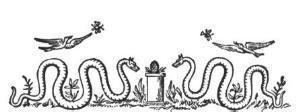 Figure 59
* See CLAVIS STOCKII, "Zebub," where it is stated that the word zebub, as applied to the fly, comes from an Arabic root, which signifies to move from place to place, as flies do, without settling anywhere. Baal-zebub, therefore, in its secret meaning, signifies, "Lord of restless and unsettled motion."** I find Lactantius was led to the conclusion that the Aesculapian servant was the express symbol of Satan, for, giving an account of the bringing of the Epidaurian snake to Rome, he says: "Thither [i.e., to Rome] the Demoniarches [or Prince of the Devils] in his own proper shape, without disguise, was brought; for those who were sent on that business brought back with them a dragon of amazing size."
When, therefore, Gratian abolished the legal provision for the support of the fire-worship and serpent-worship of Rome, we see how exactly the Divine prediction was fulfilled (Rev 12:9) "And the great dragon was cast out, that old serpent called the DEVIL, and SATAN, which deceiveth the whole world; he was cast out into the earth, and his angels were cast out with him." *
* The facts stated above cast a very singular light on a well known superstition among ourselves. Everybody has heard of St. Swithin's day, on which, if it rain, the current belief is, that it will rain in uninterrupted succession for six weeks. And who or what was St. Swithin that his day should be connected with forty days' uninterrupted rain? for six weeks is just the round number of weeks equivalent to forty days. It is evident, in the first place, that he was no Christian saint, though an Archbishop of Canterbury in the tenth century is said to have been called by his name. The patron saint of the forty days' rain was just Tammuz or Odin, who was worshipped among our ancestors as the incarnation of Noah, in whose time it rained forty days and forty nights without intermission. Tammuz and St. Swithin, then, must have been one and the same. But, as in Egypt, and Rome, and Greece, and almost everywhere else, long before the Christian era, Tammuz had come to be recognised as an incarnation of the Devil, we need not be surprised to find that St. Swithin is no other than St. Satan. One of the current forms of the grand adversary's name among the Pagans was just Sytan or Sythan. This name, as applied to the Evil Being, is found as far to the east as the kingdom of Siam. It had evidently been known to the Druids, and that in connection with the flood; for they say that it was the son of Seithin that, under the influence of drink, let in the sea over the country so as to overwhelm a large and populous district. (DAVIES, Druids) The Anglo-Saxons, when they received that name, in the very same way as they made Odin into Wodin, would naturally change Sythan into Swythan; and thus, in St. Swithin's day and the superstition therewith connected, we have at once a striking proof of the wide extent of Devil-worship in the heathen world, and of the thorough acquaintance of our Pagan ancestors with the great Scriptural fact of the forty days' incessant rain at the Deluge.If any one thinks it incredible that Satan should thus be canonised by the Papacy in the Dark Ages, let me call attention to the pregnant fact that, even in comparatively recent times, the Dragon--the Devil's universally recognised symbol--was worshipped by the Romanists of Poictiers under the name of "the good St. Vermine"!! (Notes of the Society of the Antiquaries of France, SALVERTE)
Now, as the Pagan Pontifex, to whose powers and prerogatives the Pope had served himself heir, was thus the High-priest of Satan, so, when the Pope entered into a league and alliance with that system of Devil-worship, and consented to occupy the very position of that Pontifex, and to bring all its abominations into the Church, as he has done, he necessarily became the Prime Minister of the Devil, and, of course, came as thoroughly under his power as ever the previous Pontiff had been. *
* This gives a new and darker significance to the mystic Tau, or sign of the cross. At first it was the emblem of Tammuz, at last it became the emblem of Teitan, or Satan himself.
How exact the fulfilment of the Divine statement that the coming of the Man of Sin was to be "after the working or energy of Satan." Here, then, is the grand conclusion to which we are compelled, both on historical and Scriptural grounds, to come: As the mystery of godliness is God manifest in the flesh, so the mystery of iniquity is--so far as such a thing is possible--the Devil incarnate.
Notes
Attes, the Sinner
We have seen that the name Pan signifies "to turn aside," and have concluded that as it is a synonym for Hata, "to sin," the proper generic meaning of which is "to turn aside from the straight line," that name was the name of our first parent, Adam. One of the names of Eve, as the primeval goddess, worshipped in ancient Babylon, while it gives confirmation to this conclusion, elucidates also another classical myth in a somewhat unexpected way. The name of that primeval goddess, as given by Berosus, is Thalatth, which, as we have seen, signifies "the rib." Adam's name, as her husband, would be "Baal-Thalatth," "Husband of the rib"; for Baal signifies Lord in the sense frequently of "Husband." But "Baal-Thalatth," according to a peculiar Hebrew idiom already noticed, signifies also "He that halted or went sideways." *
* The Chaldee Thalatth, "a rib" or a "side," comes from the verb Thalaa, the Chaldee form of Tzalaa, which signifies "to turn aside," "to halt," "to sidle," or "to walk sideways."
This is the remote origin of Vulcan's lameness; for Vulcan, as the "Father of the gods," needed to be identified with Adam, as well as the other "fathers of the gods," to whom we have already traced him. Now Adam, in consequence of his sin and departure from the straight line of duty, was, all his life after, in a double sense "Baal-Thalatth," not only the "Husband of the rib," but "The man that halted or walked sideways." In memory of this turning aside, no doubt it was that the priests of Baal (1 Kings 18:26) "limped at the altar," when supplicating their god to hear them (for that is the exact meaning in the original of the word rendered "leaped"--see KITTO's Bib. Cyclop), and that the Druidic priests went sideways in performing some of their sacred rites, as appears from the following passage of Davies: "The dance is performed with solemn festivity about the lakes, round which and the sanctuary the priests move sideways, whilst the sanctuary is earnestly invoking the gliding king, before whom the fair one retreats upon the veil that covers the huge stones" (Druids). This Davies regards as connected with the story of Jupiter, the father of the gods, violating his own daughter in the form of a serpent. Now, let the reader look at what is on the breast of the Ephesian Diana, as the Mother of the gods, and he will see a reference to her share in the same act of going aside; for there is the crab, and how does a crab go but sideways? This, then, shows the meaning of another of the signs of the Zodiac. Cancer commemorates the fatal turning aside of our first parent from the paths of righteousness, when the covenant of Eden was broken.
The Pagans knew that this turning aside or going sideways, implied death--the death of the soul--("In the day thou eatest thereof, thou shalt surely die"); and, therefore, while at the spring festival of Cybele and Attes, there were great lamentations for the death of Attes, so on the Hilaria or rejoicing festival of the 25th of March--that is, Lady-day, the last day of the festival--the mourning was turned into joy, "on occasion of the dead god being restored to life again" (DUPUIS, Origine de tous les Cultes). If Attes was he that by "his turning aside" brought sin and death into the world, what could the life be to which he was so speedily restored, but just that new and divine life which enters every soul when it is "born again," and so "passes from death unto life." When the promise was given that the seed of the woman should bruise the serpent's head, and Adam grasped it by faith, that, there can be no doubt, was evidence that the divine life was restored, and that he was born again. And thus do the very Mysteries of Attes, which were guarded with special jealousy, and the secret meaning of which Pausanias declares that he found it impossible, notwithstanding all his efforts to discover (Achaica), bear their distinct testimony, when once the meaning of the name of Attes is deciphered, to the knowledge which paganism itself had of the real nature of the Fall, and of the essential character of that death, which was threatened in the primeval covenant.
This new birth of Attes laid the foundation for his being represented as a little child, and so being identified with Adonis, who, though he died a full-grown man, was represented in that very way. In the Eleusinian Mysteries, that commemorated the rape of Proserpine, that is, the seduction of Eve, the lamented god, or Bacchus, was represented as a babe, at the breast of the great Mother, who by Sophocles is called Deo (Antigone). As Deo or Demete, applied to the Great Mother, is evidently just another form of Idaia Mater, "The Mother of Knowledge" (the verb "to know" being either Daa or Idaa), this little child, in one of his aspects, was no doubt the same as Attes, and thus also Deoius, as his name is given. The Hilaria, or rejoicing festival of the 25th of March, or Lady-day, owed its gladness to the Annunciation of a birth yet to come, even the birth of the woman's seed; but, at the same time, the joy of that festival was enhanced by the immediate new birth that very day of Attes, "The sinner," or Adam, who, in consequence of his breach of the covenant, had become dead in "trespasses and sins."