App
App
Section II
Sub-Section V
The Deification of the Child
If there was one who was more deeply concerned in the tragic death of Nimrod than another, it was his wife Semiramis, who, from an originally humble position, had been raised to share with him the throne of Babylon. What, in this emergency shall she do? Shall she quietly forego the pomp and pride to which she has been raised! No. Though the death of her husband has given a rude shock to her power, yet her resolution and unbounded ambition were in nowise checked. On the contrary, her ambition took a still higher flight. In life her husband had been honoured as a hero; in death she will have him worshipped as a god, yea, as the woman's promised Seed, "Zero-ashta," * who was destined to bruise the serpent's head, and who, in doing so, was to have his own heel bruised.
* Zero--in Chaldee, "the seed"--though we have seen reason to conclude that in Greek it sometimes appeared as Zeira, quite naturally passed also into Zoro, as may be seen from the change of Zerubbabel in the Greek Septuagint to Zoro-babel; and hence Zuro-ashta, "the seed of the woman" became Zoroaster, the well known name of the head of the fire-worshippers. Zoroaster's name is also found as Zeroastes (JOHANNES CLERICUS, De Chaldoeis). The reader who consults the able and very learned work of Dr. Wilson of Bombay, on the Parsi Religion, will find that there was a Zoroaster long before that Zoroaster who lived in the reign of Darius Hystaspes. In general history, the Zoroaster of Bactria is most frequently referred to; but the voice of antiquity is clear and distinct to the effect that the first and great Zoroaster was an Assyrian or Chaldean (SUIDAS), and that he was the founder of the idolatrous system of Babylon, and therefore Nimrod. It is equally clear also in stating that he perished by a violent death, even as was the case with Nimrod, Tammuz, or Bacchus. The identity of Bacchus and Zoroaster is still further proved by the epithet Pyrisporus, bestowed on Bacchus in the Orphic Hymns. When the primeval promise of Eden began to be forgotten, the meaning of the name Zero-ashta was lost to all who knew only the exoteric doctrine of Paganism; and as "ashta" signified "fire" in Chaldee, as well as "the woman," and the rites of Bacchus had much to do with fire-worship, "Zero-ashta" came to be rendered "the seed of fire"; and hence the epithet Pyrisporus, or Ignigena, "fire-born," as applied to Bacchus. From this misunderstanding of the meaning of the name Zero-ashta, or rather from its wilful perversion by the priests, who wished to establish one doctrine for the initiated, and another for the profane vulgar, came the whole story about the unborn infant Bacchus having been rescued from the flames that consumed his mother Semele, when Jupiter came in his glory to visit her. (Note to OVID'S Metam.)There was another name by which Zoroaster was known, and which is not a little instructive, and that is Zar-adas, "The only seed." (JOHANNES CLERICUS, De Chaldoeis) In WILSON'S Parsi Religion the name is given either Zoroadus, or Zarades. The ancient Pagans, while they recognised supremely one only God, knew also that there was one only seed, on whom the hopes of the world were founded. In almost all nations, not only was a great god known under the name of Zero or Zer, "the seed," and a great goddess under the name of Ashta or Isha, "the woman"; but the great god Zero is frequently characterised by some epithet which implies that he is "The only One." Now what can account for such names or epithets? Genesis 3:15 can account for them; nothing else can. The name Zar-ades, or Zoro-adus, also strikingly illustrates the saying of Paul: "He saith not, And to seeds, as of many; but as of one, and to thy seed, which is Christ."
It is worthy of notice, that the modern system of Parseeism, which dates from the reform of the old fire-worship in the time of Darius Hystaspes, having rejected the worship of the goddess-mother, cast out also from the name of their Zoroaster the name of the "woman"; and therefore in the Zend, the sacred language of the Parsees, the name of their great reformer is Zarathustra--i.e., "The Delivering Seed," the last member of the name coming from Thusht (the root being--Chaldee--nthsh, which drops the initial n), "to loosen or set loose," and so to free. Thusht is the infinitive, and ra appended to it is, in Sanscrit, with which the Zend has much affinity, the well known sign of the doer of an action, just as er is in English. The Zend Zarathushtra, then, seems just the equivalent of Phoroneus, "The Emancipator."
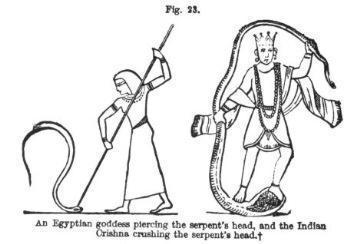
The patriarchs, and the ancient world in general, were perfectly acquainted with the grand primeval promise of Eden, and they knew right well that the bruising of the heel of the promised seed implied his death, and that the curse could be removed from the world only by the death of the grand Deliverer. If the promise about the bruising of the serpent's head, recorded in Genesis, as made to our first parents, was actually made, and if all mankind were descended from them, then it might be expected that some trace of this promise would be found in all nations. And such is the fact. There is hardly a people or kindred on earth in whose mythology it is not shadowed forth. The Greeks represented their great god Apollo as slaying the serpent Pytho, and Hercules as strangling serpents while yet in his cradle. In Egypt, in India, in Scandinavia, in Mexico, we find clear allusions to the same great truth. "The evil genius," says Wilkinson, "of the adversaries of the Egyptian god Horus is frequently figured under the form of a snake, whose head he is seen piercing with a spear. The same fable occurs in the religion of India, where the malignant serpent Calyia is slain by Vishnu, in his avatar of Crishna (see Figure 23); and the Scandinavian deity Thor was said to have bruised the head of the great serpent with his mace." "The origin of this," he adds, "may be readily traced to the Bible." In reference to a similar belief among the Mexicans, we find Humboldt saying, that "The serpent crushed by the great spirit Teotl, when he takes the form of one of the subaltern deities, is the genius of evil--a real Kakodaemon." Now, in almost all cases, when the subject is examined to the bottom, it turns out that the serpent destroying god is represented as enduring hardships and sufferings that end in his death. Thus the god Thor, while succeeding at last in destroying the great serpent, is represented as, in the very moment of victory, perishing from the venomous effluvia of his breath. The same would seem to be the way in which the Babylonians represented their great serpent-destroyer among the figures of their ancient sphere. His mysterious suffering is thus described by the Greek poet Aratus, whose language shows that when he wrote, the meaning of the representation had been generally lost, although, when viewed in this light of Scripture, it is surely deeply significant:--
"A human figure, 'whelmed with toil, appears;
Yet still with name uncertain he remains;
Nor known the labour that he thus sustains;
But since upon his knees he seems to fall,
Him ignorant mortals Engonasis call;
And while sublime his awful hands are spread,
Beneath him rolls the dragon's horrid head,
And his right foot unmoved appears to rest,
Fixed on the writhing monster's burnished crest."
The constellation thus represented is commonly known by the name of "The Kneeler," from this very description of the Greek poet; but it is plain that, as "Eugonasis" came from the Babylonians, it must be interpreted, not in a Greek, but in a Chaldee sense, and so interpreted, as the action of the figure itself implies, the title of the mysterious sufferer is just "The Serpent-crusher." Sometimes, however the actual crushing of the serpent was represented as a much more easy process; yet, even then, death was the ultimate result; and that death of the serpent-destroyer is so described as to leave no doubt whence the fable was borrowed. This is particularly the case with the Indian god Crishna, to whom Wilkinson alludes in the extract already given. In the legend that concerns him, the whole of the primeval promise in Eden is very strikingly embodied. First, he is represented in pictures and images with his foot on the great serpent's head, and then, after destroying it, he is fabled to have died in consequence of being shot by an arrow in the foot; and, as in the case of Tammuz, great lamentations are annually made for his death. Even in Greece, also, in the classic story of Paris and Achilles, we have a very plain allusion to that part of the primeval promise, which referred to the bruising of the conqueror's "heel." Achilles, the only son of a goddess, was invulnerable in all points except the heel, but there a wound was deadly. At that his adversary took aim, and death was the result.
Now, if there be such evidence still, that even Pagans knew that it was by dying that the promised Messiah was to destroy death and him that has the power of death, that is the Devil, how much more vivid must have been the impression of mankind in general in regard to this vital truth in the early days of Semiramis, when they were so much nearer the fountain-head of all Divine tradition. When, therefore, the name Zoroaster, "the seed of the woman," was given to him who had perished in the midst of a prosperous career of false worship and apostacy, there can be no doubt of the meaning which that name was intended to convey. And the fact of the violent death of the hero, who, in the esteem of his partisans, had done so much to bless mankind, to make life happy, and to deliver them from the fear of the wrath to come, instead of being fatal to the bestowal of such a title upon him, favoured rather than otherwise the daring design. All that was needed to countenance the scheme on the part of those who wished an excuse for continued apostacy from the true God, was just to give out that, though the great patron of the apostacy had fallen a prey to the malice of men, he had freely offered himself for the good of mankind. Now, this was what was actually done. The Chaldean version of the story of the great Zoroaster is that he prayed to the supreme God of heaven to take away his life; that his prayer was heard, and that he expired, assuring his followers that, if they cherished due regard for his memory, the empire would never depart from the Babylonians. What Berosus, the Babylonian historian, says of the cutting off of the head of the great god Belus, is plainly to the same effect. Belus, says Berosus, commanded one of the gods to cut off his head, that from the blood thus shed by his own command and with his own consent, when mingled with the earth, new creatures might be formed, the first creation being represented as a sort of a failure. Thus the death of Belus, who was Nimrod, like that attributed to Zoroaster, was represented as entirely voluntary, and as submitted to for the benefit of the world.
It seems to have been now only when the dead hero was to be deified, that the secret Mysteries were set up. The previous form of apostacy during the life of Nimrod appears to have been open and public. Now, it was evidently felt that publicity was out of the question. The death of the great ringleader of the apostacy was not the death of a warrior slain in battle, but an act of judicial rigour, solemnly inflicted. This is well established by the accounts of the deaths of both Tammuz and Osiris. The following is the account of Tammuz, given by the celebrated Maimonides, deeply read in all the learning of the Chaldeans: "When the false prophet named Thammuz preached to a certain king that he should worship the seven stars and the twelve signs of the Zodiac, that king ordered him to be put to a terrible death. On the night of his death all the images assembled from the ends of the earth into the temple of Babylon, to the great golden image of the Sun, which was suspended between heaven and earth. That image prostrated itself in the midst of the temple, and so did all the images around it, while it related to them all that had happened to Thammuz. The images wept and lamented all the night long, and then in the morning they flew away, each to his own temple again, to the ends of the earth. And hence arose the custom every year, on the first day of the month Thammuz, to mourn and to weep for Thammuz." There is here, of course, all the extravagance of idolatry, as found in the Chaldean sacred books that Maimonides had consulted; but there is no reason to doubt the fact stated either as to the manner or the cause of the death of Tammuz. In this Chaldean legend, it is stated that it was by the command of a "certain king" that this ringleader in apostacy was put to death. Who could this king be, who was so determinedly opposed to the worship of the host of heaven? From what is related of the Egyptian Hercules, we get very valuable light on this subject. It is admitted by Wilkinson that the most ancient Hercules, and truly primitive one, was he who was known in Egypt as having, "by the power of the gods" * (i.e., by the SPIRIT) fought against and overcome the Giants.
* The name of the true God (Elohim) is plural. Therefore, "the power of the gods," and "of God," is expressed by the same term.
Now, no doubt, the title and character of Hercules were afterwards given by the Pagans to him whom they worshipped as the grand deliverer or Messiah, just as the adversaries of the Pagan divinities came to be stigmatised as the "Giants" who rebelled against Heaven. But let the reader only reflect who were the real Giants that rebelled against Heaven. They were Nimrod and his party; for the "Giants" were just the "Mighty ones," of whom Nimrod was the leader. Who, then, was most likely to head the opposition to the apostacy from the primitive worship? If Shem was at that time alive, as beyond question he was, who so likely as he? In exact accordance with this deduction, we find that one of the names of the primitive Hercules in Egypt was "Sem."
If "Sem," then, was the primitive Hercules, who overcame the Giants, and that not by mere physical force, but by "the power of God," or the influence of the Holy Spirit, that entirely agrees with his character; and more than that, it remarkably agrees with the Egyptian account of the death of Osiris. The Egyptians say, that the grand enemy of their god overcame him, not by open violence, but that, having entered into a conspiracy with seventy-two of the leading men of Egypt, he got him into his power, put him to death, and then cut his dead body into pieces, and sent the different parts to so many different cities throughout the country. The real meaning of this statement will appear, if we glance at the judicial institutions of Egypt. Seventy-two was just the number of the judges, both civil and sacred, who, according to Egyptian law, were required to determine what was to be the punishment of one guilty of so high an offence as that of Osiris, supposing this to have become a matter of judicial inquiry. In determining such a case, there were necessarily two tribunals concerned. First, there were the ordinary judges, who had power of life and death, and who amounted to thirty, then there was, over and above, a tribunal consisting of forty-two judges, who, if Osiris was condemned to die, had to determine whether his body should be buried or no, for, before burial, every one after death had to pass the ordeal of this tribunal. *
* DIODORUS. The words of Diodorus, as printed in the ordinary editions, make the number of the judges simply "more than forty," without specifying how many more. In the Codex Coislianus, the number is stated to be "two more than forty." The earthly judges, who tried the question of burial, are admitted both by WILKINSON and BUNSEN, to have corresponded in number to the judges of the infernal regions. Now, these judges, over and above their president, are proved from the monuments to have been just forty-two. The earthly judges at funerals, therefore, must equally have been forty-two. In reference to this number as applying equally to the judges of this world and the world of spirits, Bunsen, speaking of the judgment on a deceased person in the world unseen, uses these words in the passage above referred to: "Forty-two gods (the number composing the earthly tribunal of the dead) occupy the judgment-seat." Diodorus himself, whether he actually wrote "two more than forty," or simply "more than forty," gives reason to believe that forty-two was the number he had present to his mind; for he says, that "the whole of the fable of the shades below," as brought by Orpheus from Egypt, was "copied from the ceremonies of the Egyptian funerals," which he had witnessed at the judgment before the burial of the dead. If, therefore, there were just forty-two judges in "the shades below," that even, on the showing of Diodorus, whatever reading of his words be preferred, proves that the number of the judges in the earthly judgment must have been the same.
As burial was refused him, both tribunals would necessarily be concerned; and thus there would be exactly seventy-two persons, under Typho the president, to condemn Osiris to die and to be cut in pieces. What, then, does the statement account to, in regard to the conspiracy, but just to this, that the great opponent of the idolatrous system which Osiris introduced, had so convinced these judges of the enormity of the offence which he had committed, that they gave up the offender to an awful death, and to ignominy after it, as a terror to any who might afterwards tread in his steps. The cutting of the dead body in pieces, and sending the dismembered parts among the different cities, is paralleled, and its object explained, by what we read in the Bible of the cutting of the dead body of the Levite's concubine in pieces (Judges 19:29), and sending one of the parts to each of the twelve tribes of Israel; and the similar step taken by Saul, when he hewed the two yoke of oxen asunder, and sent them throughout all the coasts of his kingdom (1 Sam 11:7). It is admitted by commentators that both the Levite and Saul acted on a patriarchal custom, according to which summary vengeance would be dealt to those who failed to come to the gathering that in this solemn way was summoned. This was declared in so many words by Saul, when the parts of the slaughtered oxen were sent among the tribes: "Whosoever cometh not forth after Saul and after Samuel, so shall it be done to his oxen." In like manner, when the dismembered parts of Osiris were sent among the cities by the seventy-two "conspirators"--in other words, by the supreme judges of Egypt, it was equivalent to a solemn declaration in their name, that "whosoever should do as Osiris had done, so should it be done to him; so should he also be cut in pieces."
When irreligion and apostacy again arose into the ascendant, this act, into which the constituted authorities who had to do with the ringleader of the apostates were led, for the putting down of the combined system of irreligion and despotism set up by Osiris or Nimrod, was naturally the object of intense abhorrence to all his sympathisers; and for his share in it the chief actor was stigmatised as Typho, or "The Evil One." *
* Wilkinson admits that different individuals at different times bore this hated name in Egypt. One of the most noted names by which Typho, or the Evil One, was called, was Seth (EPIPHANIUS, Adv. Hoeres). Now Seth and Shem are synonymous, both alike signifying "The appointed one." As Shem was a younger son of Noah, being "the brother of Japhet the elder" (Gen 10:21), and as the pre-eminence was divinely destined to him, the name Shem, "the appointed one," had doubtless been given him by Divine direction, either at his birth or afterwards, to mark him out as Seth had been previously marked out as the "child of promise." Shem, however, seems to have been known in Egypt as Typho, not only under the name of Seth, but under his own name; for Wilkinson tells us that Typho was characterised by a name that signified "to destroy and render desert." (Egyptians) Now the name of Shem also in one of its meanings signifies "to desolate" or lay waste. So Shem, the appointed one, was by his enemies made Shem, the Desolator or Destroyer--i.e., the Devil.
The influence that this abhorred Typho wielded over the minds of the so-called "conspirators," considering the physical force with which Nimrod was upheld, must have been wonderful, and goes to show, that though his deed in regard to Osiris is veiled, and himself branded by a hateful name, he was indeed none other than that primitive Hercules who overcame the Giants by "the power of God," by the persuasive might of his Holy Spirit.
In connection with this character of Shem, the myth that makes Adonis, who is identified with Osiris, perish by the tusks of a wild boar, is easily unravelled. * The tusk of a wild boar was a symbol. In Scripture, a tusk is called "a horn"; among many of the Classic Greeks it was regarded in the very same light. **
* In India, a demon with a "boar's face" is said to have gained such power through his devotion, that he oppressed the "devotees" or worshippers of the gods, who had to hide themselves. (MOOR'S Pantheon) Even in Japan there seems to be a similar myth.** Pausanian admits that some in his day regarded tusks as teeth; but he argues strongly, and, I think, conclusively, for their being considered as "horns."
When once it is known that a tusk is regarded as a "horn" according to the symbolism of idolatry, the meaning of the boar's tusks, by which Adonis perished, is not far to seek. The bull's horns that Nimrod wore were the symbol of physical power. The boar's tusks were the symbol of spiritual power. As a "horn" means power, so a tusk, that is, a horn in the mouth, means "power in the mouth"; in other words, the power of persuasion; the very power with which "Sem," the primitive Hercules, was so signally endowed. Even from the ancient traditions of the Gael, we get an item of evidence that at once illustrates this idea of power in the mouth, and connects it with that great son of Noah, on whom the blessing of the Highest, as recorded in Scripture, did specially rest. The Celtic Hercules was called Hercules Ogmius, which, in Chaldee, is "Hercules the Lamenter." *
* The Celtic scholars derive the name Ogmius from the Celtic word Ogum, which is said to denote "the secret of writing"; but Ogum is much more likely to be derived from the name of the god, than the name of the god to be derived from it.
No name could be more appropriate, none more descriptive of the history of Shem, than this. Except our first parent, Adam, there was, perhaps, never a mere man that saw so much grief as he. Not only did he see a vast apostacy, which, with his righteous feelings, and witness as he had been of the awful catastrophe of the flood, must have deeply grieved him; but he lived to bury SEVEN GENERATIONS of his descendants. He lived 502 years after the flood, and as the lives of men were rapidly shortened after that event, no less than SEVEN generations of his lineal descendants died before him (Gen 11:10-32). How appropriate a name Ogmius, "The Lamenter or Mourner," for one who had such a history! Now, how is this "Mourning" Hercules represented as putting down enormities and redressing wrongs? Not by his club, like the Hercules of the Greeks, but by the force of persuasion. Multitudes were represented as following him, drawn by fine chains of gold and amber inserted into their ears, and which chains proceeded from his mouth. *
* Sir W. BETHAM'S Gael and Cymbri. In connection with this Ogmius, one of the names of "Sem," the great Egyptian Hercules who overcame the Giants, is worthy of notice. That name is Chon. In the Etymologicum Magnum, apud BRYANT, we thus read: "They say that in the Egyptian dialect Hercules is called Chon." Compare this with WILKINSON, where Chon is called "Sem." Now Khon signifies "to lament" in Chaldee, and as Shem was Khon--i.e., "Priest" of the Most High God, his character and peculiar circumstances as Khon "the lamenter" would form an additional reason why he should be distinguished by that name by which the Egyptian Hercules was known. And it is not to be overlooked, that on the part of those who seek to turn sinners from the error of their ways, there is an eloquence in tears that is very impressive. The tears of Whitefield formed one great part of his power; and, in like manner, the tears of Khon, "the lamenting" Hercules, would aid him mightily in overcoming the Giants.
There is a great difference between the two symbols--the tusks of a boar and the golden chains issuing from the mouth, that draw willing crowds by the ears; but both very beautifully illustrate the same idea--the might of that persuasive power that enabled Shem for a time to withstand the tide of evil that came rapidly rushing in upon the world.
Now when Shem had so powerfully wrought upon the minds of men as to induce them to make a terrible example of the great Apostate, and when that Apostate's dismembered limbs were sent to the chief cities, where no doubt his system had been established, it will be readily perceived that, in these circumstances, if idolatry was to continue--if, above all, it was to take a step in advance, it was indispensable that it should operate in secret. The terror of an execution, inflicted on one so mighty as Nimrod, made it needful that, for some time to come at least, the extreme of caution should be used. In these circumstances, then, began, there can hardly be a doubt, that system of "Mystery," which, having Babylon for its centre, has spread over the world. In these Mysteries, under the seal of secrecy and the sanction of an oath, and by means of all the fertile resources of magic, men were gradually led back to all the idolatry that had been publicly suppressed, while new features were added to that idolatry that made it still more blasphemous than before. That magic and idolatry were twin sisters, and came into the world together, we have abundant evidence. "He" (Zoroaster), says Justin the historian, "was said to be the first that invented magic arts, and that most diligently studied the motions of the heavenly bodies." The Zoroaster spoken of by Justin is the Bactrian Zoroaster; but this is generally admitted to be a mistake. Stanley, in his History of Oriental Philosophy, concludes that this mistake had arisen from similarity of name, and that from this cause that had been attributed to the Bactrian Zoroaster which properly belonged to the Chaldean, "since it cannot be imagined that the Bactrian was the inventor of those arts in which the Chaldean, who lived contemporary with him, was so much skilled." Epiphanius had evidently come to the same substantial conclusion before him. He maintains, from the evidence open to him in his day, that it was "Nimrod, that established the sciences of magic and astronomy, the invention of which was subsequently attributed to (the Bactrian) Zoroaster."
As we have seen that Nimrod and the Chaldean Zoroaster are the same, the conclusions of the ancient and the modern inquirers into Chaldean antiquity entirely harmonise. Now the secret system of the Mysteries gave vast facilities for imposing on the senses of the initiated by means of the various tricks and artifices of magic. Notwithstanding all the care and precautions of those who conducted these initiations, enough has transpired to give us a very clear insight into their real character. Everything was so contrived as to wind up the minds of the novices to the highest pitch of excitement, that, after having surrendered themselves implicitly to the priests, they might be prepared to receive anything. After the candidates for initiation had passed through the confessional, and sworn the required oaths, "strange and amazing objects," says Wilkinson, "presented themselves. Sometimes the place they were in seemed to shake around them; sometimes it appeared bright and resplendent with light and radiant fire, and then again covered with black darkness, sometimes thunder and lightning, sometimes frightful noises and bellowings, sometimes terrible apparitions astonished the trembling spectators." Then, at last, the great god, the central object of their worship, Osiris, Tammuz, Nimrod or Adonis, was revealed to them in the way most fitted to soothe their feelings and engage their blind affections. An account of such a manifestation is thus given by an ancient Pagan, cautiously indeed, but yet in such a way as shows the nature of the magic secret by which such an apparent miracle was accomplished: "In a manifestation which one must not reveal...there is seen on a wall of the temple a mass of light, which appears at first at a very great distance. It is transformed, while unfolding itself, into a visage evidently divine and supernatural, of an aspect severe, but with a touch of sweetness. Following the teachings of a mysterious religion, the Alexandrians honour it as Osiris or Adonis." From this statement, there can hardly be a doubt that the magical art here employed was none other than that now made use of in the modern phantasmagoria. Such or similar means were used in the very earliest periods for presenting to the view of the living, in the secret Mysteries, those who were dead. We have statements in ancient history referring to the very time of Semiramis, which imply that magic rites were practised for this very purpose; * and as the magic lantern, or something akin to it, was manifestly used in later times for such an end, it is reasonable to conclude that the same means, or similar, were employed in the most ancient times, when the same effects were produced.
* One of the statements to which I refer is contained in the following words of Moses of Chorene in his Armenian History, referring to the answer made by Semiramis to the friends of Araeus, who had been slain in battle by her: "I have given commands, says Semiramis, to my gods to lick the wounds of Araeus, and to raise him from the dead. The gods, says she, have licked Araeus, and recalled him to life." If Semiramis had really done what she said she had done, it would have been a miracle. The effects of magic were sham miracles; and Justin and Epiphanius show that sham miracles came in at the very birth of idolatry. Now, unless the sham miracle of raising the dead by magical arts had already been known to be practised in the days of Semiramis, it is not likely that she would have given such an answer to those whom she wished to propitiate; for, on the one hand, how could she ever have thought of such an answer, and on the other, how could she expect that it would have the intended effect, if there was no current belief in the practice of necromancy? We find that in Egypt, about the same age, such magic arts must have been practised, if Manetho is to be believed. "Manetho says," according to Josephus, "that he [the elder Horus, evidently spoken of as a human and mortal king] was admitted to the sight of the gods, and that Amenophis desired the same privilege." This pretended admission to the right of the gods evidently implied the use of the magic art referred to in the text.
Now, in the hands of crafty, designing men, this was a powerful means of imposing upon those who were willing to be imposed upon, who were averse to the holy spiritual religion of the living God, and who still hankered after the system that was put down. It was easy for those who controlled the Mysteries, having discovered secrets that were then unknown to the mass of mankind, and which they carefully preserved in their own exclusive keeping, to give them what might seem ocular demonstration, that Tammuz, who had been slain, and for whom such lamentations had been made, was still alive, and encompassed with divine and heavenly glory. From the lips of one so gloriously revealed, or what was practically the same, from the lips of some unseen priest, speaking in his name from behind the scenes, what could be too wonderful or incredible to be believed? Thus the whole system of the secret Mysteries of Babylon was intended to glorify a dead man; and when once the worship of one dead man was established, the worship of many more was sure to follow. This casts light upon the language of the 106th Psalm, where the Lord, upbraiding Israel for their apostacy, says: "They joined themselves to Baalpeor, and ate the sacrifices of the dead." Thus, too, the way was paved for bringing in all the abominations and crimes of which the Mysteries became the scenes; for, to those who liked not to retain God in their knowledge, who preferred some visible object of worship, suited to the sensuous feelings of their carnal minds, nothing could seem a more cogent reason for faith or practice than to hear with their own ears a command given forth amid so glorious a manifestation apparently by the very divinity they adored.
The scheme, thus skilfully formed, took effect. Semiramis gained glory from her dead and deified husband; and in course of time both of them, under the names of Rhea and Nin, or "Goddess-Mother and Son," were worshipped with an enthusiasm that was incredible, and their images were everywhere set up and adored. *
* It would seem that no public idolatry was ventured upon till the reign of the grandson of Semiramis, Arioch or Arius. (Cedreni Compendium)
Wherever the Negro aspect of Nimrod was found an obstacle to his worship, this was very easily obviated. According to the Chaldean doctrine of the transmigration of souls, all that was needful was just to teach that Ninus had reappeared in the person of a posthumous son, of a fair complexion, supernaturally borne by his widowed wife after the father had gone to glory. As the licentious and dissolute life of Semiramis gave her many children, for whom no ostensible father on earth would be alleged, a plea like this would at once sanctify sin, and enable her to meet the feelings of those who were disaffected to the true worship of Jehovah, and yet might have not fancy to bow down before a Negro divinity. From the light reflected on Babylon by Egypt, as well as from the form of the extant images of the Babylonian child in the arms of the goddess-mother, we have every reason to believe that this was actually done. In Egypt the fair Horus, the son of the black Osiris, who was the favourite object of worship, in the arms of the goddess Isis, was said to have been miraculously born in consequence of a connection, on the part of that goddess, with Osiris after his death, and, in point of fact, to have been a new incarnation of that god, to avenge his death on his murderers. It is wonderful to find in what widely-severed countries, and amongst what millions of the human race at this day, who never saw a Negro, a Negro god is worshipped. But yet, as we shall afterwards see, among the civilised nations of antiquity, Nimrod almost everywhere fell into disrepute, and was deposed from his original pre-eminence, expressly ob deformitatem, "on account of his ugliness." Even in Babylon itself, the posthumous child, as identified with his father, and inheriting all his father's glory, yet possessing more of his mother's complexion, came to be the favourite type of the Madonna's divine son.
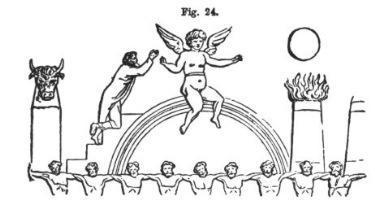
This son, thus worshipped in his mother's arms, was looked upon as invested with all the attributes, and called by almost all the names of the promised Messiah. As Christ, in the Hebrew of the Old Testament, was called Adonai, The Lord, so Tammuz was called Adon or Adonis. Under the name of Mithras, he was worshipped as the "Mediator." As Mediator and head of the covenant of grace, he was styled Baal-berith, Lord of the Covenant (see Figure 24) - (Judges 8:33). In this character he is represented in Persian monuments as seated on the rainbow, the well known symbol of the covenant. In India, under the name of Vishnu, the Preserver or Saviour of men, though a god, he was worshipped as the great "Victim-Man," who before the worlds were, because there was nothing else to offer, offered himself as a sacrifice. The Hindoo sacred writings teach that this mysterious offering before all creation is the foundation of all the sacrifices that have ever been offered since. *
* In the exercise of his office as the Remedial god, Vishnu is said to "extract the thorns of the three worlds." (MOOR'S Pantheon) "Thorns" were a symbol of the curse--Genesis 3:18.
Do any marvel at such a statement being found in the sacred books of a Pagan mythology? Why should they? Since sin entered the world there has been only one way of salvation, and that through the blood of the everlasting covenant--a way that all mankind once knew, from the days of righteous Abel downwards. When Abel, "by faith," offered unto God his more excellent sacrifice than that of Cain, it was his faith "in the blood of the Lamb slain," in the purpose of God "from the foundation of the world," and in due time to be actually offered up on Calvary, that gave all the "excellence" to his offering. If Abel knew of "the blood of the Lamb," why should Hindoos not have known of it? One little word shows that even in Greece the virtue of "the blood of God" had once been known, though that virtue, as exhibited in its poets, was utterly obscured and degraded. That word is Ichor. Every reader of the bards of classic Greece knows that Ichor is the term peculiarly appropriated to the blood of a divinity. Thus Homer refers to it:
"From the clear vein the immortal Ichor flowed,
Such stream as issues from a wounded god,
Pure emanation, uncorrupted flood,
Unlike our gross, diseased terrestrial blood."
Now, what is the proper meaning of the term Ichor? In Greek it has no etymological meaning whatever; but, in Chaldee, Ichor signifies "The precious thing." Such a name, applied to the blood of a divinity, could have only one origin. It bears its evidence on the very face of it, as coming from that grand patriarchal tradition, that led Abel to look forward to the "precious blood" of Christ, the most "precious" gift that love Divine could give to a guilty world, and which, while the blood of the only genuine "Victim-Man," is at the same time, in deed and in truth, "The blood of God" (Acts 20:28). Even in Greece itself, though the doctrine was utterly perverted, it was not entirely lost. It was mingled with falsehood and fable, it was hid from the multitude; but yet, in the secret mystic system it necessarily occupied an important place. As Servius tells us that the grand purpose of the Bacchic orgies "was the purification of souls," and as in these orgies there was regularly the tearing asunder and the shedding of the blood of an animal, in memory of the shedding of the life's blood of the great divinity commemorated in them, could this symbolical shedding of the blood of that divinity have no bearing on the "purification" from sin, these mystic rites were intended to effect? We have seen that the sufferings of the Babylonian Zoroaster and Belus were expressly represented as voluntary, and as submitted to for the benefit of the world, and that in connection with crushing the great serpent's head, which implied the removal of sin and the curse. If the Grecian Bacchus was just another form of the Babylonian divinity, then his sufferings and blood-shedding must have been represented as having been undergone for the same purpose--viz., for the "purification of souls." From this point of view, let the well known name of Bacchus in Greece be looked at. The name was Dionysus or Dionusos. What is the meaning of that name? Hitherto it has defied all interpretation. But deal with it as belonging to the language of that land from which the god himself originally came, and the meaning is very plain. D'ion-nuso-s signifies "THE SIN-BEARER," * a name entirely appropriate to the character of him whose sufferings were represented as so mysterious, and who was looked up to as the great "purifier of souls."
* The expression used in Exodus 28:38, for "bearing iniquity" or in a vicarious manner is "nsha eon" (the first letter eon being ayn). A synonym for eon, "iniquity," is aon (the first letter being aleph). In Chaldee the first letter a becomes i, and therefore aon, "iniquity," is ion. Then nsha "to bear," in the participle active is "nusha." As the Greeks had no sh, that became nusa. De, or Da, is the demonstrative pronoun signifying "That" or "The great." And thus "D'ion-nusa" is exactly "The great sin-bearer." That the classic Pagans had the very idea of the imputation of sin, and of vicarious suffering, is proved by what Ovid says in regard to Olenos. Olenos is said to have taken upon him and willingly to have borne the blame of guilt of which he was innocent. Under the load of this imputed guilt, voluntarily taken upon himself, Olenos is represented as having suffered such horror as to have perished, being petrified or turned into stone. As the stone into which Olenos was changed was erected on the holy mountain of Ida, that shows that Olenos must have been regarded as a sacred person. The real character of Olenos, as the "sin-bearer," can be very fully established. (see note below)
Now, this Babylonian god, known in Greece as "The sin-bearer," and in India as the "Victim-Man," among the Buddhists of the East, the original elements of whose system are clearly Babylonian, was commonly addressed as the "Saviour of the world." It has been all along well enough known that the Greeks occasionally worshipped the supreme god under the title of "Zeus the Saviour"; but this title was thought to have reference only to deliverance in battle, or some suck-like temporal deliverance. But when it is known that "Zeus the Saviour" was only a title of Dionysus, the "sin-bearing Bacchus," his character, as "The Saviour," appears in quite a different light. In Egypt, the Chaldean god was held up as the great object of love and adoration, as the god through whom "goodness and truth were revealed to mankind." He was regarded as the predestined heir of all things; and, on the day of his birth, it was believed that a voice was heard to proclaim, "The Lord of all the earth is born." In this character he was styled "King of kings, and Lord of lords," it being as a professed representative of this hero-god that the celebrated Sesostris caused this very title to be added to his name on the monuments which he erected to perpetuate the fame of his victories. Not only was he honoured as the great "World King," he was regarded as Lord of the invisible world, and "Judge of the dead"; and it was taught that, in the world of spirits, all must appear before his dread tribunal, to have their destiny assigned them. As the true Messiah was prophesied of under the title of the "Man whose name was the branch," he was celebrated not only as the "Branch of Cush," but as the "Branch of God," graciously given to the earth for healing all the ills that flesh is heir to. * He was worshipped in Babylon under the name of El-Bar, or "God the Son." Under this very name he is introduced by Berosus, the Chaldean historian, as the second in the list of Babylonian sovereigns. **
* This is the esoteric meaning of Virgil's "Golden Branch," and of the Mistletoe Branch of the Druids. The proof of this must be reserved to the Apocalypse of the Past. I may remark, however, in passing, on the wide extent of the worship of a sacred branch. Not only do the Negroes in Africa in the worship of the Fetiche, on certain occasions, make use of a sacred branch (HURD'S Rites and Ceremonies), but even in India there are traces of the same practice. My brother, S. Hislop, Free Church Missionary at Nagpore, informs me that the late Rajah of Nagpore used every year, on a certain day, to go in state to worship the branch of a particular species of tree, called Apta, which had been planted for the occasion, and which, after receiving divine honours, was plucked up, and its leaves distributed by the native Prince among his nobles. In the streets of the city numerous boughs of the same kind of tree were sold, and the leaves presented to friends under the name of sona, or "gold."** BEROSUS, in BUNSEN'S Egypt. The name "El-Bar" is given above in the Hebrew form, as being more familiar to the common reader of the English Bible. The Chaldee form of the name is Ala-Bar, which in the Greek of Berosus, is Ala-Par, with the ordinary Greek termination os affixed to it. The change of Bar into Par in Greek is just on the same principle as Ab, "father," in Greek becomes Appa, and Bard, the "spotted one," becomes Pardos, &c. This name, Ala-Bar, was probably given by Berosus to Ninyas as the legitimate son and successor of Nimrod. That Ala-Par-os was really intended to designate the sovereign referred to, as "God the Son," or "the Son of God," is confirmed by another reading of the same name as given in Greek. There the name is Alasparos. Now Pyrsiporus, as applied to Bacchus, means Ignigena, or the "Seed of Fire"; and Ala-sporos, the "Seed of God," is just a similar expression formed in the same way, the name being Grecised.
Under this name he has been found in the sculptures of Nineveh by Layard, the name Bar "the Son," having the sign denoting El or "God" prefixed to it. Under the same name he has been found by Sir H. Rawlinson, the names "Beltis" and the "Shining Bar" being in immediate juxtaposition. Under the name of Bar he was worshipped in Egypt in the earliest times, though in later times the god Bar was degraded in the popular Pantheon, to make way for another more popular divinity. In Pagan Rome itself, as Ovid testifies, he was worshipped under the name of the "Eternal Boy." * Thus daringly and directly was a mere mortal set up in Babylon in opposition to the "Son of the Blessed."
* To understand the true meaning of the above expression, reference must be had to a remarkable form of oath among the Romans. In Rome the most sacred form of an oath was (as we learn from AULUS GELLIUS), "By Jupiter the STONE." This, as it stands, is nonsense. But translate "lapidem" [stone] back into the sacred tongue, or Chaldee, and the oath stands, "By Jove, the Son," or "By the son of Jove." Ben, which in Hebrew is Son, in Chaldee becomes Eben, which also signifies a stone, as may be seen in "Eben-ezer," "The stone of help." Now as the most learned inquirers into antiquity have admitted that the Roman Jovis, which was anciently the nominative, is just a form of the Hebrew Jehovah, it is evident that the oath had originally been, "by the son of Jehovah." This explains how the most solemn and binding oath had been taken in the form above referred to; and,it shows, also, what was really meant when Bacchus, "the son of Jovis," was called "the Eternal Boy." (OVID, Metam.)
Notes
Olenos, the Sin-Bearer
Note 1: In different portions of this work evidence has been brought to show that Saturn, "the father of gods and men," was in one aspect just our first parent Adam. Now, of Saturn it is said that he devoured all his children. *
* Sometimes he is said to have devoured only his male children; but see SMITH'S (Larger) Classical Dictionary, "Hera," where it will be found that the female as well as the male were devoured.
In the exoteric story, among those who knew not the actual fact referred to, this naturally appeared in the myth, in the shape in which we commonly find it--viz., that he devoured them all as soon as they were born. But that which was really couched under the statement, in regard to his devouring his children, was just the Scriptural fact of the Fall--viz., that he destroyed them by eating--not by eating them, but by eating the forbidden fruit. When this was the sad and dismal state of matters, the Pagan story goes on to say that the destruction of the children of the father of gods and men was arrested by means of his wife, Rhea. Rhea, as we have already seen, had really as much to do with the devouring of Saturn's children, as Saturn himself; but, in the progress of idolatry and apostacy, Rhea, or Eve, came to get glory at Saturn's expense. Saturn, or Adam, was represented as a morose divinity; Rhea, or Eve, exceedingly benignant; and, in her benignity, she presented to her husband a stone bound in swaddling bands, which he greedily devoured, and henceforth the children of the cannibal father were safe. The stone bound in swaddling bands is, in the sacred language, "Ebn Hatul"; but Ebn-Hat-tul * also signifies "A sin-bearing son."
* Hata, "sin," is found also in Chaldee, Hat. Tul is from Ntl, "to support." If the reader will look at Horus with his swathes (BRYANT); Diana with the bandages round her legs; the symbolic bull of the Persian swathed in like manner, and even the shapeless log of the Tahitians, used as a god and bound about with ropes (WILLIAMS); he will see, I think, that there must be some important mystery in this swathing.
This does not necessarily mean that Eve, or the mother of mankind, herself actually brought forth the promised seed (although there are many myths also to that effect), but that, having received the glad tidings herself, and embraced it, she presented it to her husband, who received it by faith from her, and that this laid the foundation of his own salvation and that of his posterity. The devouring on the part of Saturn of the swaddled stone is just the symbolical expression of the eagerness with which Adam by faith received the good news of the woman's seed; for the act of faith, both in the Old Testament and in the New, is symbolised by eating. Thus Jeremiah says,
"Thy words were found of me, and I did eat them, and thy word was unto me the joy and rejoicing of my heart" (Jer 15:16).
This also is strongly shown by our Lord Jesus Christ Himself, who, while setting before the Jews the indispensable necessity of eating His flesh, and feeding on Him, did at the same time say:
"It is the Spirit that quickeneth; the flesh profiteth nothing: the words that I speak unto you, they are spirit, and they are life" (John 6:63).
That Adam eagerly received the good news about the promised seed, and treasured it up in his heart as the life of his soul, is evident from the name which he gave to his wife immediately after hearing it:
"And Adam called his wife's name Eve, because she was the mother of all living ones" (Gen 3:20).
The story of the swaddled stone does not end with the swallowing of it, and the arresting of the ruin of the children of Saturn. This swaddled stone was said to be "preserved near the temple of Delphi, where care was taken to anoint it daily with oil, and to cover it with wool" (MAURICE'S Indian Antiquities). If this stone symbolised the "sin-bearing son," it of course symbolised also the Lamb of God, slain from the foundation of the world, in whose symbolic covering our first parents were invested when God clothed them in the coats of skins. Therefore, though represented to the eye as a stone, he must have the appropriate covering of wool. When represented as a branch, the branch of God, the branch also was wrapped in wool (POTTER, Religion of Greece). The daily anointing with oil is very significant. If the stone represented the "sin-bearing son," what could the anointing of that "sin-bearing son" daily with oil mean, but just to point him out as the "Lord's Anointed," or the "Messiah," whom the idolatrous worshipped in opposition to the true Messiah yet to be revealed?
One of the names by which this swaddled and anointed stone was called is very strikingly confirmatory of the above conclusion. That name is Baitulos. This we find from Priscian, who, speaking of "that stone which Saturn is said to have devoured for Jupiter," adds, whom the Greeks called "Baitulos." Now, "B'hai-tuloh" signifies the "Life-restoring child." *
* From Tli, Tleh, or Tloh, "Infans puer" (CLAVIS STOCKII, Chald.), and Hia, or Haya, "to live, to restore life." (GESENIUS) From Hia, "to live," with digamma prefixed, comes the Greek "life." That Hia, when adopted into Greek, was also pronounced Haya, we have evidence in he noun Hiim, "life," pronounced Hayyim, which in Greek is represented by "blood." The Mosaic principle, that "the blood was the life," is thus proved to have been known by others besides the Jews. Now Haya, "to live or restore life," with the digamma prefixed, becomes B'haya: and so in Egypt, we find that Bai signified "soul," or "spirit" (BUNSEN), which is the living principle. B'haitulos, then, is the "Life-restoring child." P'haya-n is the same god.
The father of gods and men had destroyed his children by eating; but the reception of "the swaddled stone" is said to have "restored them to life" (HESIOD, Theogon.). Hence the name Baitulos; and this meaning of the name is entirely in accordance with what is said in Sanchuniathon about the Baithulia made by the Phoenician god Ouranos: "It was the god Ouranos who devised Baithulia, contriving stones that moved as having life." If the stone Baitulos represented the "life-restoring child," it was natural that that stone should be made, if possible, to appear as having "life" in itself.
Now, there is a great analogy between this swaddled stone that represented the "sin-bearing son," and that Olenos mentioned by Ovid, who took on him guilt not his own, and in consequence was changed into a stone. We have seen already that Olenos, when changed into a stone, was set up in Phrygia on the holy mountain of Ida. We have reason to believe that the stone which was fabled to have done so much for the children of Saturn, and was set up near the temple of Delphi, was just a representation of this same Olenos. We find that Olen was the first prophet at Delphi, who founded the first temple there (PAUSA Phocica). As the prophets and priests generally bore the names of the gods whom they represented (Hesychius expressly tells us that the priest who represented the great god under the name of the branch in the mysteries was himself called by the name of Bacchus), this indicates one of the ancient names of the god of Delphi. If, then, there was a sacred stone on Mount Ida called the stone of Olenos, and a sacred stone in the precincts of the temple of Delphi, which Olen founded, can there be a doubt that the sacred stone of Delphi represented the same as was represented by the sacred stone of Ida? The swaddled stone set up at Delphi is expressly called by Priscian, in the place already cited, "a god." This god, then, that in symbol was divinely anointed, and was celebrated as having restored to life the children of Saturn, father of gods and men, as identified with the Idaean Olenos, is proved to have been regarded as occupying the very place of the Messiah, the great Sin-bearer, who came to bear the sins of men, and took their place and suffered in their room and stead; for Olenos, as we have seen, voluntarily took on him guilt of which he was personally free.
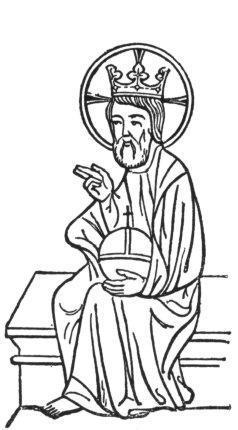 While thus we have seen how much of the patriarchal faith was hid under the mystical symbols of Paganism, there is yet a circumstance to be noted in regard to the swaddled stone, that shows how the Mystery of Iniquity in Rome has contrived to import this swaddled stone of Paganism into what is called Christian symbolism. The Baitulos, or swaddled stone, was a round or globular stone. This globular stone is frequently represented swathed and bound, sometimes with more, sometimes with fewer bandages. In BRYANT, where the goddess Cybele is represented as "Spes Divina," or Divine hope, we see the foundation of this divine hope held out to the world in the representation of the swaddled stone at her right hand, bound with four different swathes. In DAVID'S Antiquites Etrusques, we find a goddess represented with Pandora's box, the source of all ill, in her extended hand, and the swaddled globe depending from it; and in this case that globe has only two bandages, the one crossing the other. And what is this bandage globe of Paganism but just the counterpart of that globe, with a band around it, and the mystic Tau, or cross, on the top of it, that is called "the type of dominion," and is frequently represented, as in the accompanying woodcut (see Figure 60), in the hands of the profane representations of God the Father. The reader does not now need to be told that the cross is the chosen sign and mark of that very God whom the swaddled stone represented; and that when that God was born, it was said, "The Lord of all the earth is born" (WILKINSON). As the god symbolised by the swaddled stone not only restored the children of Saturn to life, but restored the lordship of the earth to Saturn himself, which by transgression he had lost, it is not to be wondered at that it is said of "these consecrated stones," that while "some were dedicated to Jupiter, and others to the sun," "they were considered in a more particular manner sacred to Saturn," the Father of the gods (MAURICE), and that Rome, in consequence, has put the round stone into the hand of the image, bearing the profaned name of God the Father attached to it, and that from his source the bandaged globe, surmounted with the mark of Tammuz, has become the symbol of dominion throughout all Papal Europe.