App
App
Section II
Sub-Section I
The Child in Assyria
The original of that mother, so widely worshipped, there is reason to believe, was Semiramis, * already referred to, who, it is well known, was worshipped by the Babylonians, and other eastern nations, and that under the name of Rhea, the great Goddess "Mother."
* Sir H. Rawlinson having found evidence at Nineveh, of the existence of a Semiramis about six or seven centuries before the Christian era, seems inclined to regard her as the only Semiramis that ever existed. But this is subversive of all history. The fact that there was a Semiramis in the primeval ages of the world, is beyond all doubt, although some of the exploits of the latter queen have evidently been attributed to her predecessor. Mr. Layard dissents from Sir. H. Rawlinson's opinion.
It was from the son, however, that she derived all her glory and her claims to deification. That son, though represented as a child in his mother's arms, was a person of great stature and immense bodily powers, as well as most fascinating manners. In Scripture he is referred to (Eze 8:14) under the name of Tammuz, but he is commonly known among classical writers under the name of Bacchus, that is, "The Lamented one." *
* From Bakhah "to weep" or "lament." Among the Phoenicians, says Hesychius, "Bacchos means weeping." As the women wept for Tammuz, so did they for Bacchus.
To the ordinary reader the name of Bacchus suggests nothing more than revelry and drunkenness, but it is now well known, that amid all the abominations that attended his orgies, their grand design was professedly "the purification of souls," and that from the guilt and defilement of sin. This lamented one, exhibited and adored as a little child in his mother's arms, seems, in point of fact, to have been the husband of Semiramis, whose name, Ninus, by which he is commonly known in classical history, literally signified "The Son." As Semiramis, the wife, was worshipped as Rhea, whose grand distinguishing character was that of the great goddess "Mother," * the conjunction with her of her husband, under the name of Ninus, or "The Son," was sufficient to originate the peculiar worship of the "Mother and Son," so extensively diffused among the nations of antiquity; and this, no doubt, is the explanation of the fact which has so much puzzled the inquirers into ancient history, that Ninus is sometimes called the husband, and sometimes the son of Semiramis.
* As such Rhea was called by the Greeks, Ammas. Ammas is evidently the Greek form of the Chaldee Ama, "Mother."
This also accounts for the origin of the very same confusion of relationship between Isis and Osiris, the mother and child of the Egyptians; for as Bunsen shows, Osiris was represented in Egypt as at once the son and husband of his mother; and actually bore, as one of his titles of dignity and honour, the name "Husband of the Mother." * This still further casts light on the fact already noticed, that the Indian God Iswara is represented as a babe at the breast of his own wife Isi, or Parvati.
* BUNSEN. It may be observed that this very name "Husband of the Mother," given to Osiris, seems even at this day to be in common use among ourselves, although there is not the least suspicion of the meaning of the term, or whence it has come. Herodotus mentions that when in Egypt, he was astonished to hear the very same mournful but ravishing "Song of Linus," sung by the Egyptians (although under another name), which he had been accustomed to hear in his own native land of Greece. Linus was the same god as the Bacchus of Greece, or Osiris of Egypt; for Homer introduces a boy singing the song of Linus, while the vintage is going on (Ilias), and the Scholiast says that this son was sung in memory of Linus, who was torn in pieces by dogs. The epithet "dogs," applied to those who tore Linus in pieces, is evidently used in a mystical sense, and it will afterwards been seen how thoroughly the other name by which he is known--Narcissus--identifies him with the Greek Bacchus and Egyptian Osiris. In some places in Egypt, for the song of Linus or Osiris, a peculiar melody seems to have been used. Savary says that, in the temple of Abydos, "the priest repeated the seven vowels in the form of hymns, and that musicians were forbid to enter it." (Letters) Strabo, whom Savary refers to, calls the god of that temple Memnon, but we learn from Wilkinson that Osiris was the great god of Abydos, whence it is evident that Memnon and Osiris were only different names of the same divinity. Now the name of Linus or Osiris, as the "husband of his mother," in Egypt, was Kamut (BUNSEN). When Gregory the Great introduced into the Church of Rome what are now called the Gregorian Chants, he got them from the Chaldean mysteries, which had long been established in Rome; for the Roman Catholic priest, Eustace, admits that these chants were largely composed of "Lydian and Phrygian tunes" (Classical Tour), Lydia and Phrygia being among the chief seats in later times of those mysteries, of which the Egyptian mysteries were only a branch. These tunes were sacred--the music of the great god, and in introducing them Gregory introduced the music of Kamut. And thus, to all appearance, has it come to pass, that the name of Osiris or Kamut, "the husband of the mother," is in every-day use among ourselves as the name of the musical scale; for what is the melody of Osiris, consisting of the "seven vowels" formed into a hymn, but--the Gamut?
Now, this Ninus, or "Son," borne in the arms of the Babylonian Madonna, is so described as very clearly to identify him with Nimrod. "Ninus, king of the Assyrians," * says Trogus Pompeius, epitomised by Justin, "first of all changed the contented moderation of the ancient manners, incited by a new passion, the desire of conquest. He was the first who carried on war against his neighbours, and he conquered all nations from Assyria to Lybia, as they were yet unacquainted with the arts of war."
* The name, "Assyrians," as has already been noticed, has a wide latitude of meaning among the classic authors, taking in the Babylonians as well as the Assyrians proper.
This account points directly to Nimrod, and can apply to no other. The account of Diodorus Siculus entirely agrees with it, and adds another trait that goes still further to determine the identity. That account is as follows: "Ninus, the most ancient of the Assyrian kings mentioned in history, performed great actions. Being naturally of a warlike disposition, and ambitious of glory that results from valour, he armed a considerable number of young men that were brave and vigorous like himself, trained them up a long time in laborious exercises and hardships, and by that means accustomed them to bear the fatigues of war, and to face dangers with intrepidity." As Diodorus makes Ninus "the most ancient of the Assyrian kings," and represents him as beginning those wars which raised his power to an extraordinary height by bringing the people of Babylonia under subjection to him, while as yet the city of Babylon was not in existence, this shows that he occupied the very position of Nimrod, of whom the Scriptural account is, that he first "began to be mighty on the earth," and that the "beginning of his kingdom was Babylon." As the Babel builders, when their speech was confounded, were scattered abroad on the face of the earth, and therefore deserted both the city and the tower which they had commenced to build, Babylon as a city, could not properly be said to exist till Nimrod, by establishing his power there, made it the foundation and starting-point of his greatness. In this respect, then, the story of Ninus and of Nimrod exactly harmonise. The way, too, in which Ninus gained his power is the very way in which Nimrod erected his. There can be no doubt that it was by inuring his followers to the toils and dangers of the chase, that he gradually formed them to the use of arms, and so prepared them for aiding him in establishing his dominions; just as Ninus, by training his companions for a long time "in laborious exercises and hardships," qualified them for making him the first of the Assyrian kings.
The conclusions deduced from these testimonies of ancient history are greatly strengthened by many additional considerations. In Genesis 10:11, we find a passage, which, when its meaning is properly understood, casts a very steady light on the subject. That passage, as given in the authorised version, runs thus:
"Out of that land went forth Asshur, and builded Nineveh."
This speaks of it as something remarkable, that Asshur went out of the land of Shinar, while yet the human race in general went forth from the same land. It goes upon the supposition that Asshur had some sort of divine right to that land, and that he had been, in a manner, expelled from it by Nimrod, while no divine right is elsewhere hinted at in the context, or seems capable of proof. Moreover, it represents Asshur as setting up in the IMMEDIATE NEIGHBOURHOOD of Nimrod as mighty a kingdom as Nimrod himself, Asshur building four cities, one of which is emphatically said to have been "great" (v 12); while Nimrod, on this interpretation, built just the same number of cities, of which none is specially characterised as "great." Now, it is in the last degree improbable that Nimrod would have quietly borne so mighty a rival so near him. To obviate such difficulties as these, it has been proposed to render the words, "out of that land he (Nimrod) went forth into Asshur, or Assyria." But then, according to ordinary usage of grammar, the word in the original should have been "Ashurah," with the sign of motion to a place affixed to it, whereas it is simply Asshur, without any such sign of motion affixed. I am persuaded that the whole perplexity that commentators have hitherto felt in considering this passage, has arisen from supposing that there is a proper name in the passage, where in reality no proper name exists. Asshur is the passive participle of a verb, which, in its Chaldee sense, signifies "to make strong," and, consequently, signifies "being strengthened," or "made strong." Read thus, the whole passage is natural and easy (v 10):
"And the beginning of his (Nimrod's) kingdom was Babel, and Erech, and Accad, and Calneh."
A beginning naturally implies something to succeed, and here we find it (v 11):
"Out of that land he went forth, being made strong, or when he had been made strong (Ashur), and builded Nineveh," &c.
Now, this exactly agrees with the statement in the ancient history of Justin: "Ninus strengthened the greatness of his acquired dominion by continued possession. Having subdued, therefore, his neighbours, when, by an accession of forces, being still further strengthened, he went forth against other tribes, and every new victory paved the way for another, he subdued all the peoples of the East." Thus, then, Nimrod, or Ninus, was the builder of Nineveh; and the origin of the name of that city, as "the habitation of Ninus," is accounted for, * and light is thereby, at the same time, cast on the fact, that the name of the chief part of the ruins of Nineveh is Nimroud at this day.
* Nin-neveh, "The habitation of Ninus."
Now, assuming that Ninus is Nimrod, the way in which that assumption explains what is otherwise inexplicable in the statements of ancient history greatly confirms the truth of that assumption itself. Ninus is said to have been the son of Belus or Bel, and Bel is said to have been the founder of Babylon. If Ninus was in reality the first king of Babylon, how could Belus or Bel, his father, be said to be the founder of it? Both might very well be, as will appear if we consider who was Bel, and what we can trace of his doings. If Ninus was Nimrod, who was the historical Bel? He must have been Cush; for "Cush begat Nimrod" (Gen 10:8); and Cush is generally represented as having been a ringleader in the great apostacy. * But again, Cush, as the son of Ham, was Her-mes or Mercury; for Hermes is just an Egyptian synonym for the "son of Ham." **
* See GREGORIUS TURONENSIS, De rerum Franc. Gregory attributes to Cush what was said more generally to have befallen his son; but his statement shows the belief in his day, which is amply confirmed from other sources, that Cush had a pre-eminent share in leading mankind away from the true worship of God.** The composition of Her-mes is, first, from "Her," which, in Chaldee, is synonymous with Ham, or Khem, "the burnt one." As "her" also, like Ham, signified "The hot or burning one," this name formed a foundation for covertly identifying Ham with the "Sun," and so deifying the great patriarch, after whose name the land of Egypt was called, in connection with the sun. Khem, or Ham, in his own name was openly worshipped in later ages in the land of Ham (BUNSEN); but this would have been too daring at first. By means of "Her," the synonym, however, the way was paved for this. "Her" is the name of Horus, who is identified with the sun (BUNSEN), which shows the real etymology of the name to be from the verb to which I have traced it. Then, secondly, "Mes," is from Mesheh (or, without the last radical, which is omissible), Mesh, "to draw forth." In Egyptian, we have Ms in the sense of "to bring forth" (BUNSEN, Hieroglyphical Signs), which is evidently a different form of the same word. In the passive sense, also, we find Ms used (BUNSEN, Vocabulary). The radical meaning of Mesheh in Stockii Lexicon, is given in Latin "Extraxit," and our English word "extraction," as applied to birth or descent, shows that there is a connection between the generic meaning of this word and birth. This derivation will be found to explain the meaning of the names of the Egyptian kings, Ramesses and Thothmes, the former evidently being "The son of Ra," or the Sun; the latter in like manner, being "The son of Thoth." For the very same reason Her-mes is the "Son of Her, or Ham," the burnt one--that is, Cush.
Now, Hermes was the great original prophet of idolatry; for he was recognised by the pagans as the author of their religious rites, and the interpreter of the gods. The distinguished Gesenius identifies him with the Babylonian Nebo, as the prophetic god; and a statement of Hyginus shows that he was known as the grand agent in that movement which produced the division of tongues. His words are these: "For many ages men lived under the government of Jove [evidently not the Roman Jupiter, but the Jehovah of the Hebrews], without cities and without laws, and all speaking one language. But after that Mercury interpreted the speeches of men (whence an interpreter is called Hermeneutes), the same individual distributed the nations. Then discord began." *
* HYGINUS, Fab. Phoroneus is represented as king at this time.
Here there is a manifest enigma. How could Mercury or Hermes have any need to interpret the speeches of mankind when they "all spake one language"? To find out the meaning of this, we must go to the language of the Mysteries. Peresh, in Chaldee, signifies "to interpret"; but was pronounced by old Egyptians and by Greeks, and often by the Chaldees themselves, in the same way as "Peres," to "divide." Mercury, then, or Hermes, or Cush, "the son of Ham," was the "DIVIDER of the speeches of men." He, it would seem, had been the ringleader in the scheme for building the great city and tower of Babel; and, as the well known title of Hermes,--"the interpreter of the gods," would indicate, had encouraged them, in the name of God, to proceed in their presumptuous enterprise, and so had caused the language of men to be divided, and themselves to be scattered abroad on the face of the earth. Now look at the name of Belus or Bel, given to the father of Ninus, or Nimrod, in connection with this. While the Greek name Belus represented both the Baal and Bel of the Chaldees, these were nevertheless two entirely distinct titles. These titles were both alike often given to the same god, but they had totally different meanings. Baal, as we have already seen, signified "The Lord"; but Bel signified "The Confounder." When, then, we read that Belus, the father of Ninus, was he that built or founded Babylon, can there be a doubt, in what sense it was that the title of Belus was given to him? It must have been in the sense of Bel the "Confounder." And to this meaning of the name of the Babylonian Bel, there is a very distinct allusion in Jeremiah 50:2, where it is said "Bel is confounded," that is, "The Confounder is brought to confusion." That Cush was known to Pagan antiquity under the very character of Bel, "The Confounder," a statement of Ovid very clearly proves. The statement to which I refer is that in which Janus "the god of gods," * from whom all the other gods had their origin, is made to say of himself: "The ancients...called me Chaos."
* Janus was so called in the most ancient hymns of the Salii. (MACROB, Saturn.)
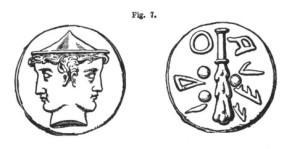 Now, first this decisively shows that Chaos was known not merely as a state of confusion, but as the "god of Confusion." But, secondly, who that is at all acquainted with the laws of Chaldaic pronunciation, does not know that Chaos is just one of the established forms of the name of Chus or Cush? * Then, look at the symbol of Janus, ** (see figure 7) whom "the ancients called Chaos," and it will be seen how exactly it tallies with the doings of Cush, when he is identified with Bel, "The Confounder." That symbol is a club; and the name of "a club" in Chaldee comes from the very word which signifies "to break in pieces, or scatter abroad." ***
* The name of Cush is also Khus, for sh frequently passes in Chaldee into s; and Khus, in pronunciation, legitimately becomes Khawos, or, without the digamma, Khaos.** From Sir WM. BETHAM'S Etruscan Literature and Antiquities Investigated, 1842. The Etruscan name on the reverse of a medal--Bel-athri, "Lord of spies," is probably given to Janus, in allusion to his well known title "Janus Tuens," which may be rendered "Janus the Seer," or "All-seeing Janus."
*** In Proverbs 25:18, a maul or club is "Mephaitz." In Jeremiah 51:20, the same word, without the Jod, is evidently used for a club (though, in our version, it is rendered battle-axe); for the use of it is not to cut asunder, but to "break in pieces." See the whole passage.
He who caused the confusion of tongues was he who "broke" the previously united earth (Gen 11:1) "in pieces," and "scattered" the fragments abroad. How significant, then, as a symbol, is the club, as commemorating the work of Cush, as Bel, the "Confounder"? And that significance will be all the more apparent when the reader turns to the Hebrew of Genesis 11:9, and finds that the very word from which a club derives its name is that which is employed when it is said, that in consequence of the confusion of tongues, the children of men were "scattered abroad on the face of all the earth." The word there used for scattering abroad is Hephaitz, which, in the Greek form becomes Hephaizt, * and hence the origin of the well known but little understood name of Hephaistos, as applied to Vulcan, "The father of the gods." **
* There are many instances of a similar change. Thus Botzra becomes in Greek, Bostra; and Mitzraim, Mestraim.** Vulcan, in the classical Pantheon, had not commonly so high a place, but in Egypt Hephaistos, or Vulcan, was called "Father of the gods." (AMMIANUS MARCELLINUS)
Hephaistos is the name of the ringleader in the first rebellion, as "The Scatterer abroad," as Bel is the name of the same individual as the "Confounder of tongues." Here, then, the reader may see the real origin of Vulcan's Hammer, which is just another name for the club of Janus or Chaos, "The god of Confusion"; and to this, as breaking the earth in pieces, there is a covert allusion in Jeremiah 50:23, where Babylon, as identified with its primeval god, is thus apostrophised: "How is the hammer of the whole earth cut asunder and broken"! Now, as the tower-building was the first act of open rebellion after the flood, and Cush, as Bel, was the ringleader in it, he was, of course, the first to whom the name Merodach, "The great Rebel," * must have been given, and, therefore, according to the usual parallelism of the prophetic language, we find both names of the Babylonian god referred to together, when the judgment on Babylon is predicted: "Bel is confounded: Merodach is broken in pieces" (Jer 1:2).
* Merodach comes from Mered, to rebel; and Dakh, the demonstrative pronoun affixed, which makes it emphatic, signifying "That" or "The great."
The judgment comes upon the Babylonian god according to what he had done. As Bel, he had "confounded" the whole earth, therefore he is "confounded." As Merodach, by the rebellion he had stirred up, he had "broken" the united world in pieces; therefore he himself is "broken in pieces."
So much for the historical character of Bel, as identified with Janus or Chaos, the god of confusion, with his symbolical club. *
* While the names Bel and Hephaistos had the origin above referred to, they were not inappropriate names also, though in a different sense, for the war-gods descending from Cush, from whom Babylon derived its glory among the nations. The warlike deified kings of the line of Cush gloried in their power to carry confusion among their enemies, to scatter their armies, and to "break the earth in pieces" by their resistless power. To this, no doubt, as well as to the acts of the primeval Bel, there is allusion in the inspired denunciations of Jeremiah on Babylon. The physical sense also of these names was embodied in the club given to the Grecian Hercules--the very club of Janus--when, in a character quite different from that of the original Hercules, he was set up as the great reformer of the world, by mere physical force. When two-headed Janus with the club is represented, the two-fold representation was probably intended to represent old Cush, and young Cush or Nimrod, as combined. But the two-fold representation with other attributes, had reference also to another "Father of the gods," afterwards to be noticed, who had specially to do with water.
Proceeding, then, on these deductions, it is not difficult to see how it might be said that Bel or Belus, the father of Ninus, founded Babylon, while, nevertheless, Ninus or Nimrod was properly the builder of it. Now, though Bel or Cush, as being specially concerned in laying the first foundations of Babylon, might be looked upon as the first king, as in some of the copies of "Eusebius' Chronicle" he is represented, yet it is evident, from both sacred history and profane, that he could never have reigned as king of the Babylonian monarchy, properly so called; and accordingly, in the Armenian version of the "Chronicle of Eusebius," which bears the undisputed palm for correctness and authority, his name is entirely omitted in the list of Assyrian kings, and that of Ninus stands first, in such terms as exactly correspond with the Scriptural account of Nimrod. Thus, then, looking at the fact that Ninus is currently made by antiquity the son of Belus, or Bel, when we have seen that the historical Bel is Cush, the identity of Ninus and Nimrod is still further confirmed.
But when we look at what is said of Semiramis, the wife of Ninus, the evidence receives an additional development. That evidence goes conclusively to show that the wife of Ninus could be none other than the wife of Nimrod, and, further, to bring out one of the grand characters in which Nimrod, when deified, was adored. In Daniel 11:38, we read of a god called Ala Mahozine *--i.e., the "god of fortifications."
* In our version, Ala Mahozim is rendered alternatively "god of forces," or "gods protectors." To the latter interpretation, there is this insuperable objection, that Ala is in the singular. Neither can the former be admitted; for Mahozim, or Mauzzim, does not signify "forces," or "armies," but "munitions," as it is also given in the margin--that is "fortifications." Stockius, in his Lexicon, gives us the definition of Mahoz in the singular, rober, arx, locus munitus, and in proof of the definition, the following examples:--Judges 6:26, "And build an altar to the Lord thy God upon the top of this rock" (Mahoz, in the margin "strong place"); and Daniel 11:19, "Then shall he turn his face to the fort (Mahoz) of his own land."
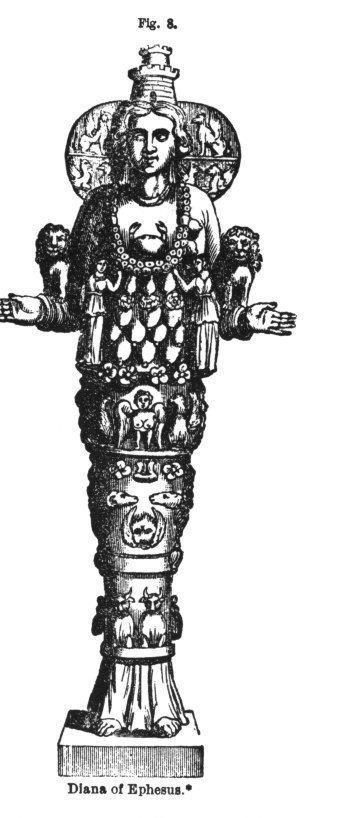 Who this god of fortifications could be, commentators have found themselves at a loss to determine. In the records of antiquity the existence of any god of fortifications has been commonly overlooked; and it must be confessed that no such god stands forth there with any prominence to the ordinary reader. But of the existence of a goddess of fortifications, every one knows that there is the amplest evidence. That goddess is Cybele, who is universally represented with a mural or turreted crown, or with a fortification, on her head. Why was Rhea or Cybele thus represented? Ovid asks the question and answers it himself; and the answer is this: The reason he says, why the statue of Cybele wore a crown of towers was, "because she first erected them in cities." The first city in the world after the flood (from whence the commencement of the world itself was often dated) that had towers and encompassing walls, was Babylon; and Ovid himself tells us that it was Semiramis, the first queen of that city, who was believed to have "surrounded Babylon with a wall of brick." Semiramis, then, the first deified queen of that city and tower whose top was intended to reach to heaven, must have been the prototype of the goddess who "first made towers in cities." When we look at the Ephesian Diana, we find evidence to the very same effect. In general, Diana was depicted as a virgin, and the patroness of virginity; but the Ephesian Diana was quite different. She was represented with all the attributes of the Mother of the gods (see Figure 8), and, as the Mother of the gods, she wore a turreted crown, such as no one can contemplate without being forcibly reminded of the tower of Babel. Now this tower-bearing Diana is by an ancient scholiast expressly identified with Semiramis.*
* A scholiast on the Periergesis of Dionysius, says Layard (Nineveh and its Remains), makes Semiramis the same as the goddess Artemis or Despoina. Now, Artemis was Diana, and the title of Despoina given to her, shows that it was in the character of the Ephesian Diana she was identified with Semiramis; for Despoina is the Greek for Domina, "The Lady," the peculiar title of Rhea or Cybele, the tower-bearing goddess, in ancient Rome. (OVID, Fasti)
When, therefore, we remember that Rhea or Cybele, the tower-bearing goddess, was, in point of fact, a Babylonian goddess, and that Semiramis, when deified, was worshipped under the name of Rhea, there will remain, I think, no doubt as to the personal identity of the "goddess of fortifications."
Now there is no reason to believe that Semiramis alone (though some have represented the matter so) built the battlements of Babylon. We have the express testimony of the ancient historian, Megasthenes, as preserved by Abydenus, that it was "Belus" who "surrounded Babylon with a wall." As "Bel," the Confounder, who began the city and tower of Babel, had to leave both unfinished, this could not refer to him. It could refer only to his son Ninus, who inherited his father's title, and who was the first actual king of the Babylonian empire, and, consequently Nimrod. The real reason that Semiramis, the wife of Ninus, gained the glory of finishing the fortifications of Babylon, was, that she came in the esteem of the ancient idolaters to hold a preponderating position, and to have attributed to her all the different characters that belonged, or were supposed to belong, to her husband. Having ascertained, then, one of the characters in which the deified wife was worshipped, we may from that conclude what was the corresponding character of the deified husband. Layard distinctly indicates his belief that Rhea or Cybele, the "tower-crown" goddess, was just the female counterpart of the "deity presiding over bulwarks or fortresses" and that this deity was Ninus, or Nimrod, we have still further evidence from what the scattered notices of antiquity say of the first deified king of Babylon, under a name that identifies him as the husband of Rhea, the "tower-bearing" goddess. That name is Kronos or Saturn. *
* In the Greek mythology, Kronos and Rhea are commonly brother and sister. Ninus and Semiramis, according to history, are not represented as standing in any such relation to one another; but this is no objection to the real identity of Ninus and Kronos; for, 1st, the relationships of the divinities, in most countries, are peculiarly conflicting--Osiris, in Egypt, is represented at different times, not only as the son and husband of Isis, but also as her father and brother (BUNSEN); then, secondly, whatever the deified mortals might be before deification, on being deified they came into new relationships. On the apotheosis of husband and wife, it was necessary for the dignity of both that both alike should be represented as of the same celestial origin--as both supernaturally the children of God. Before the flood, the great sin that brought ruin on the human race was, that the "Sons of God" married others than the daughters of God,--in other words, those who were not spiritually their "sisters." (Gen 6:2,3) In the new world, while the influence of Noah prevailed, the opposite practice must have been strongly inculcated; for a "son of God" to marry any one but a daughter of God, or his own "sister" in the faith, must have been a misalliance and a disgrace. Hence, from a perversion of a spiritual idea, came, doubtless, the notion of the dignity and purity of the royal line being preserved the more intact through the marriage of royal brothers and sisters. This was the case in Peru (PRESCOTT), in India (HARDY), and in Egypt (WILKINSON). Hence the relation of Jupiter to Juno, who gloried that she was "soror et conjux"--"sister and wife"--of her husband. Hence the same relation between Isis and her husband Osiris, the former of whom is represented as "lamenting her brother Osiris." (BUNSEN) For the same reason, no doubt, was Rhea, made the sister of her husband Kronos, to show her divine dignity and equality.
It is well known that Kronos, or Saturn, was Rhea's husband; but it is not so well known who was Kronos himself. Traced back to his original, that divinity is proved to have been the first king of Babylon. Theophilus of Antioch shows that Kronos in the east was worshipped under the names of Bel and Bal; and from Eusebius we learn that the first of the Assyrian kings, whose name was Belus, was also by the Assyrians called Kronos. As the genuine copies of Eusebius do not admit of any Belus, as an actual king of Assyria, prior to Ninus, king of the Babylonians, and distinct from him, that shows that Ninus, the first king of Babylon, was Kronos. But, further, we find that Kronos was king of the Cyclops, who were his brethren, and who derived that name from him, * and that the Cyclops were known as "the inventors of tower-building."
* The scholiast upon EURIPIDES, Orest, says that "the Cyclops were so called from Cyclops their king." By this scholiast the Cyclops are regarded as a Thracian nation, for the Thracians had localised the tradition, and applied it to themselves; but the following statement of the scholiast on the Prometheus of Aeschylus, shows that they stood in such a relation to Kronos as proves that he was their king: "The Cyclops...were the brethren of Kronos, the father of Jupiter."
The king of the Cyclops, "the inventors of tower-building," occupied a position exactly correspondent to that of Rhea, who "first erected (towers) in cities." If, therefore, Rhea, the wife of Kronos, was the goddess of fortifications, Kronos or Saturn, the husband of Rhea, that is, Ninus or Nimrod, the first king of Babylon, must have been Ala mahozin, "the god of fortifications." (see note below)
The name Kronos itself goes not a little to confirm the argument. Kronos signifies "The Horned one." As a horn is a well known Oriental emblem for power or might, Kronos, "The Horned one," was, according to the mystic system, just a synonym for the Scriptural epithet applied to Nimrod--viz., Gheber, "The mighty one" (Gen 10:8), "He began to be mighty on the earth." The name Kronos, as the classical reader is well aware, is applied to Saturn as the "Father of the gods." We have already had another "father of the gods" brought under our notice, even Cush in his character of Bel the Confounder, or Hephaistos, "The Scatterer abroad"; and it is easy to understand how, when the deification of mortals began, and the "mighty" Son of Cush was deified, the father, especially considering the part which he seems to have had in concocting the whole idolatrous system, would have to be deified too, and of course, in his character as the Father of the "Mighty one," and of all the "immortals" that succeeded him. But, in point of fact, we shall find, in the course of our inquiry, that Nimrod was the actual Father of the gods, as being the first of deified mortals; and that, therefore, it is in exact accordance with historical fact that Kronos, the Horned, or Mighty one, is, in the classic Pantheon, known by that title.
The meaning of this name Kronos, "The Horned one," as applied to Nimrod, fully explains the origin of the remarkable symbol, so frequently occurring among the Nineveh sculptures, the gigantic HORNED man-bull, as representing the great divinities in Assyria. The same word that signified a bull, signified also a ruler or prince. *
* The name for a bull or ruler, is in Hebrew without points, Shur, which in Chaldee becomes Tur. From Tur, in the sense of a bull, comes the Latin Taurus; and from the same word, in the sense of a ruler, Turannus, which originally had no evil meaning. Thus, in these well known classical words, we have evidence of the operation of the very principle which caused the deified Assyrian kings to be represented under the form of the man-bull.
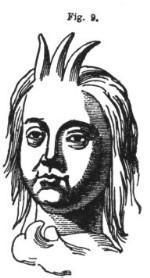 Hence the "Horned bull" signified "The Mighty Prince," thereby pointing back to the first of those "Mighty ones," who, under the name of Guebres, Gabrs, or Cabiri, occupied so conspicuous a place in the ancient world, and to whom the deified Assyrian monarchs covertly traced back the origin of their greatness and might. This explains the reason why the Bacchus of the Greeks was represented as wearing horns, and why he was frequently addressed by the epithet "Bull-horned," as one of the high titles of his dignity. Even in comparatively recent times, Togrul Begh, the leader of the Seljukian Turks, who came from the neighbourhood of the Euphrates, was in a similar manner represented with three horns growing out of his head, as the emblem of his sovereignty (see Figure 9).
This, also, in a remarkable way accounts for the origin of one of the divinities worshipped by our Pagan Anglo-Saxon ancestors under the name of Zernebogus. This Zernebogus was "the black, malevolent, ill-omened divinity," in other words, the exact counterpart of the popular idea of the Devil, as supposed to be black, and equipped with horns and hoofs. This name analysed and compared with the accompanying woodcut (see Figure 10), from Layard, casts a very singular light on the source from whence has come the popular superstition in regard to the grand Adversary. The name Zer-Nebo-Gus is almost pure Chaldee, and seems to unfold itself as denoting "The seed of the prophet Cush." We have seen reason already to conclude that, under the name Bel, as distinguished from Baal, Cush was the great soothsayer or false prophet worshipped at Babylon. But independent inquirers have been led to the conclusion that Bel and Nebo were just two different titles for the same god, and that a prophetic god. Thus does Kitto comment on the words of Isaiah 46:1 "Bel boweth down, Nebo stoopeth," with reference to the latter name: "The word seems to come from Nibba, to deliver an oracle, or to prophesy; and hence would mean an 'oracle,' and may thus, as Calmet suggests ('Commentaire Literal'), be no more than another name for Bel himself, or a characterising epithet applied to him; it being not unusual to repeat the same thing, in the same verse, in equivalent terms." "Zer-Nebo-Gus," the great "seed of the prophet Cush," was, of course, Nimrod; for Cush was Nimrod's father.
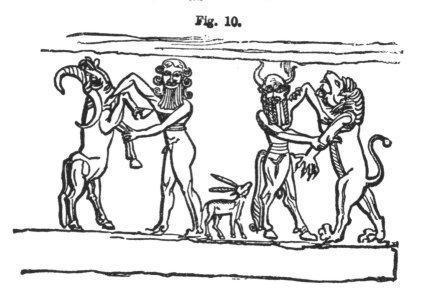
Turn now to Layard, and see how this land of ours and Assyria are thus brought into intimate connection. In a woodcut, first we find "the Assyrian Hercules," that is "Nimrod the giant," as he is called in the Septuagint version of Genesis, without club, spear, or weapons of any kind, attacking a bull. Having overcome it, he sets the bull's horns on his head, as a trophy of victory and a symbol of power; and thenceforth the hero is represented, not only with the horns and hoofs above, but from the middle downwards, with the legs and cloven feet of the bull. Thus equipped he is represented as turning next to encounter a lion. This, in all likelihood, is intended to commemorate some event in the life of him who first began to be mighty in the chase and in war, and who, according to all ancient traditions, was remarkable also for bodily power, as being the leader of the Giants that rebelled against heaven. Now Nimrod, as the son of Cush, was black, in other words, was a Negro. "Can the Ethiopian change his skin?" is in the original, "Can the Cushite" do so? Keeping this, then, in mind, it will be seen that in that figure disentombed from Nineveh, we have both the prototype of the Anglo-Saxon Zer-Nebo-Gus, "the seed of the prophet Cush," and the real original of the black Adversary of mankind, with horns and hoofs. It was in a different character from that of the Adversary that Nimrod was originally worshipped; but among a people of a fair complexion, as the Anglo-Saxons, it was inevitable that, if worshipped at all, it must generally be simply as an object of fear; and so Kronos, "The Horned one," who wore the "horns," as the emblem both of his physical might and sovereign power, has come to be, in popular superstition, the recognised representative of the Devil.
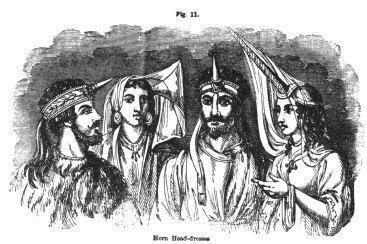 In many and far-severed countries, horns became the symbols of sovereign power. The corona or crown, that still encircles the brows of European monarchs, seems remotely to be derived from the emblem of might adopted by Kronos, or Saturn, who, according to Pherecydes, was "the first before all others that ever wore a crown." The first regal crown appears to have been only a band, in which the horns were set. From the idea of power contained in the "horn," even subordinate rulers seem to have worn a circlet adorned with a single horn, in token of their derived authority. Bruce, the Abyssinian traveller gives examples of Abyssinian chiefs thus decorated (see Figure 11), in regard to whom he states that the horn attracted his particular attention, when he perceived that the governors of provinces were distinguished by this head-dress.*
* See KITTO'S Illustrated Commentary, vol. iv. pp. 280-282. In Figure 11, the two male figures are Abyssinian Chiefs. The two females, whom Kitto has grouped along with them, are ladies of Mount Lebanon, whose horned head-dresses Walpole regards as relics of the ancient worship of Astarte. (See above - and WALPOLE'S Ansayri, vol. iii. p. 16)
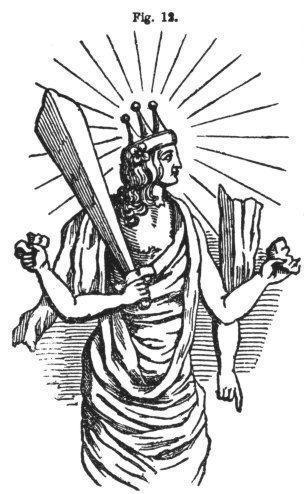 In the case of sovereign powers, the royal head-band was adorned sometimes with a double, sometimes with a triple horn. The double horn had evidently been the original symbol of power or might on the part of sovereigns; for, on the Egyptian monuments, the heads of the deified royal personages have generally no more than the two horns to shadow forth their power. As sovereignty in Nimrod's case was founded on physical force, so the two horns of the bull were the symbols of that physical force. And, in accordance with this, we read in Sanchuniathon that "Astarte put on her own head a bull's head as the ensign of royalty." By-and-by, however, another and a higher idea came in, and the expression of that idea was seen in the symbol of the three horns. A cap seems in course of time to have come to be associated with the regal horns. In Assyria the three-horned cap was one of the "sacred emblems," in token that the power connected with it was of celestial origin,--the three horns evidently pointing at the power of the trinity. Still, we have indications that the horned band, without any cap, was anciently the corona or royal crown. The crown borne by the Hindoo god Vishnu, in his avatar of the Fish, is just an open circle or band, with three horns standing erect from it, with a knob on the top of each horn (see Figure 12 ). All the avatars are represented as crowned with a crown that seems to have been modelled from this, consisting of a coronet with three points, standing erect from it, in which Sir William Jones recognises the Ethiopian or Parthian coronet.
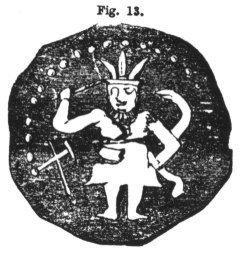
The open tiara of Agni, the Hindoo god of fire, shows in its lower round the double horn, made in the very same way as in Assyria, proving at once the ancient custom, and whence that custom had come. Instead of the three horns, three horn-shaped leaves came to be substituted (see Figure 13); and thus the horned band gradually passed into the modern coronet or crown with the three leaves of the fleur-de-lis, or other familiar three-leaved adornings.
Among the Red Indians of America there had evidently been something entirely analogous to the Babylonian custom of wearing the horns; for, in the "buffalo dance" there, each of the dancers had his head arrayed with buffalo's horns; and it is worthy of especial remark, that the "Satyric dance," * or dance of the Satyrs in Greece, seems to have been the counterpart of this Red Indian solemnity; for the satyrs were horned divinities, and consequently those who imitated their dance must have had their heads set off in imitation of theirs.
* BRYANT. The Satyrs were the companions of Bacchus, and "danced along with him" (Aelian Hist.) When it is considered who Bacchus was, and that his distinguishing epithet was "Bull-horned," the horns of the "Satyrs" will appear in their true light. For a particular mystic reason the Satyr's horn was commonly a goat's horn, but originally it must have been the same as Bacchus'.
When thus we find a custom that is clearly founded on a form of speech that characteristically distinguished the region where Nimrod's power was wielded, used in so many different countries far removed from one another, where no such form of speech was used in ordinary life, we may be sure that such a custom was not the result of mere accident, but that it indicates the wide-spread diffusion of an influence that went forth in all directions from Babylon, from the time that Nimrod first "began to be mighty on the earth."
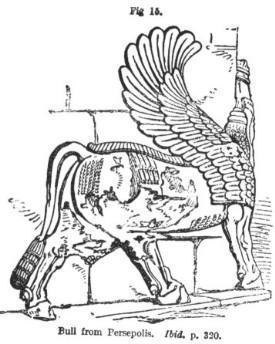
There was another way in which Nimrod's power was symbolised besides by the "horn." A synonym for Gheber, "The mighty one," was "Abir," while "Aber" also signified a "wing." Nimrod, as Head and Captain of those men of war, by whom he surrounded himself, and who were the instruments of establishing his power, was "Baal-aberin," "Lord of the mighty ones." But "Baal-abirin" (pronounced nearly in the same way) signified "The winged one," * and therefore in symbol he was represented, not only as a horned bull, but as at once a horned and winged bull--as showing not merely that he was mighty himself, but that he had mighty ones under his command, who were ever ready to carry his will into effect, and to put down all opposition to his power; and to shadow forth the vast extent of his might, he was represented with great and wide-expanding wings.
* This is according to a peculiar Oriental idiom, of which there are many examples. Thus, Baal-aph, "lord of wrath," signifies "an angry man"; Baal-lashon, "lord of tongue," "an eloquent man"; Baal-hatsim, "lord of arrows," "an archer"; and in like manner, Baal-aberin, "lord of wings," signifies "winged one."
To this mode of representing the mighty kings of Babylon and Assyria, who imitated Nimrod and his successors, there is manifest allusion in Isaiah 8:6-8
"Forasmuch as this people refuseth the waters of Shiloah that go softly, and rejoice in Rezin and Remaliah's son; now therefore, behold, the Lord bringeth up upon them the waters of the river, strong and mighty, even the king of Assyria, and all his glory; and he shall come up over all his banks. And he shall pass through Judah; he shall overflow and go over; he shall reach even unto the neck; and the STRETCHING OUT OF HIS WINGS shall FILL the breadth of thy land, O Immanuel."
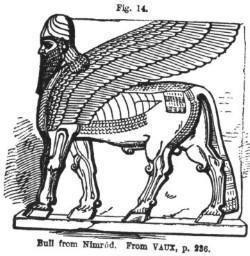 When we look at such figures as those which are here presented to the reader (see Figure 14 and Figure 15 below), with their great extent of expanded wing, as symbolising an Assyrian king, what a vividness and force does it give to the inspired language of the prophet! And how clear is it, also, that the stretching forth of the Assyrian monarch's WINGS, that was to "fill the breadth of Immanuel's land," has that very symbolic meaning to which I have referred--viz., the overspreading of the land by his "mighty ones," or hosts of armed men, that the king of Babylon was to bring with him in his overflowing invasion! The knowledge of the way in which the Assyrian monarchs were represented, and of the meaning of that representation, gives additional force to the story of the dream of Cyrus the Great, as told by Herodotus. Cyrus, says the historian, dreamt that he saw the son of one of his princes, who was at the time in a distant province, with two great "wings on his shoulders, the one of which overshadowed Asia, and the other Europe," from which he immediately concluded that he was organising rebellion against him. The symbols of the Babylonians, whose capital Cyrus had taken, and to whose power he had succeeded, were entirely familiar to him; and if the "wings" were the symbols of sovereign power, and the possession of them implied the lordship over the might, or the armies of the empire, it is easy to see how very naturally any suspicions of disloyalty affecting the individual in question might take shape in the manner related, in the dreams of him who might harbour these suspicions.
 Now, the understanding of this equivocal sense of "Baal-aberin" can alone explain the remarkable statement of Aristophanes, that at the beginning of the world "the birds" were first created, and then after their creation, came the "race of the blessed immortal gods." This has been regarded as either an atheistical or nonsensical utterance on the part of the poet, but, with the true key applied to the language, it is found to contain an important historical fact. Let it only be borne in mind that "the birds"--that is, the "winged ones"--symbolised "the Lords of the mighty ones," and then the meaning is clear, viz., that men first "began to be mighty on the earth"; and then, that the "Lords" or Leaders of "these mighty ones" were deified. The knowledge of the mystic sense of this symbol accounts also for the origin of the story of Perseus, the son of Jupiter, miraculously born of Danae, who did such wondrous things, and who passed from country to country on wings divinely bestowed on him. This equally casts light on the symbolic myths in regard to Bellerophon, and the feats which he performed on his winged horse, and their ultimate disastrous issue; how high he mounted in the air, and how terrible was his fall; and of Icarus, the son of Daedalus, who, flying on wax-cemented wings over the Icarian Sea, had his wings melted off through his too near approach to the sun, and so gave his name to the sea where he was supposed to have fallen. The fables all referred to those who trode, or were supposed to have trodden, in the steps of Nimrod, the first "Lord of the mighty ones," and who in that character was symbolised as equipped with wings.
Now, it is remarkable that, in the passage of Aristophanes already referred to, that speaks of the birds, or "the winged ones," being produced before the gods, we are informed that he from whom both "mighty ones" and gods derived their origin, was none other than the winged boy Cupid. *
* Aristophanes says that Eros or Cupid produced the "birds" and "gods" by "mingling all things." This evidently points to the meaning of the name Bel, which signifies at once "the mingler" and "the confounder." This name properly belonged to the father of Nimrod, but, as the son was represented as identified with the father, we have evidence that the name descended to the son and others by inheritance.
Cupid, the son of Venus, occupied, as will afterwards be proved, in the mystic mythology the very same position as Nin, or Ninus, "the son," did to Rhea, the mother of the gods. As Nimrod was unquestionably the first of "the mighty ones" after the Flood, this statement of Aristophanes, that the boy-god Cupid, himself a winged one, produced all the birds or "winged ones," while occupying the very position of Nin or Ninus, "the son," shows that in this respect also Ninus and Nimrod are identified. While this is the evident meaning of the poet, this also, in a strictly historical point of view, is the conclusion of the historian Apollodorus; for he states that "Ninus is Nimrod." And then, in conformity with this identity of Ninus and Nimrod, we find, in one of the most celebrated sculptures of ancient Babylon, Ninus and his wife Semiramis represented as actively engaged in the pursuits of the chase,--"the quiver-bearing Semiramis" being a fit companion for "the mighty Hunter before the Lord."
Notes
Ala-Mahozim
NOTE: The name "Ala-Mahozim" is never, as far as I know, found in any ancient uninspired author, and in the Scripture itself it is found only in a prophecy. Considering that the design of prophecy is always to leave a certain obscurity before the event, though giving enough of light for the practical guidance of the upright, it is not to be wondered at that an unusual word should be employed to describe the divinity in question. But, though this precise name be not found, we have a synonym that can be traced home to Nimrod. In Sanchuniathon, "Astarte, traveling about the habitable world," is said to have found "a star falling through the air, which she took up and consecrated in the holy island Tyre." Now what is this story of the falling star but just another version of the fall of Mulciber from heaven, or of Nimrod from his high estate? for as we have already seen, Macrobius shows (Saturn.) that the story of Adonis--the lamented one--so favourite a theme in Phoenicia, originally came from Assyria. The name of the great god in the holy island of Tyre, as is well known, was Melkart (KITTO'S Illus. Comment.), but this name, as brought from Tyre to Carthage, and from thence to Malta (which was colonised from Carthage), where it is found on a monument at this day, cast no little light on the subject. The name Melkart is thought by some to have been derived from Melek-eretz, or "king of the earth" (WILKINSON); but the way in which it is sculptured in Malta shows that it was really Melek-kart, "king of the walled city." Kir, the same as the Welsh Caer, found in Caer-narvon, &c., signifies "an encompassing wall," or a "city completely walled round"; and Kart was the feminine form of the same word, as may be seen in the different forms of the name of Carthage, which is sometimes Car-chedon, and sometimes Cart-hada or Cart-hago.
In the Book of Proverbs we find a slight variety of the feminine form of Kart, which seems evidently used in the sense of a bulwark or a fortification. Thus (Prov 10:15) we read: "A rich man's wealth is his strong city (Karit), that is, his strong bulwark or defence." Melk-kart, then, "king of the walled city," conveys the very same idea as Ala-Mahozim. In GRUTER'S Inscriptions, as quoted by Bryant, we find a title also given to Mars, the Roman war-god, exactly coincident in meaning with that of Melkart. We have elsewhere seen abundant reason to conclude that the original of Mars was Nimrod. The title to which I refer confirms this conclusion, and is contained in a Roman inscription on an ancient temple in Spain. This title shows that the temple was dedicated to "Mars Kir-aden," the lord of "The Kir," or "walled city." The Roman C, as is well known, is hard, like K; and Adon, "Lord," is also Aden. Now, with this clue to guide us, we can unravel at once what has hitherto greatly puzzled mythologists in regard to the name of Mars Quirinus as distinguished from Mars Gradivus. The K in Kir is what in Hebrew or Chaldee is called Koph, a different letter from Kape, and is frequently pronounced as a Q. Quir-inus, therefore, signifies "belonging to the 93 walled city," and refers to the security which was given to cities by encompassing walls. Gradivus, on the other hand, comes from "Grah," "conflict," and "divus," "god"--a different form of Deus, which has been already shown to be a Chaldee term; and therefore signifies "God of battle." Both these titles exactly answer to the two characters of Nimrod as the great city builder and the great warrior, and that both these distinctive characters were set forth by the two names referred to, we have distinct evidence in FUSS'S Antiquities. "The Romans," says he, "worshipped two idols of the kind [that is, gods under the name of Mars], the one called Quirinus, the guardian of the city and its peace; the other called Gradivus, greedy of war and slaughter, whose temple stood beyond the city's boundaries."