App
App
Section I
Trinity in Unity
If there be this general coincidence between the systems of Babylon and Rome, the question arises, Does the coincidence stop here? To this the answer is, Far otherwise. We have only to bring the ancient Babylonian Mysteries to bear on the whole system of Rome, and then it will be seen how immensely the one has borrowed from the other. These Mysteries were long shrouded in darkness, but now the thick darkness begins to pass away. All who have paid the least attention to the literature of Greece, Egypt, Phoenicia, or Rome are aware of the place which the "Mysteries" occupied in these countries, and that, whatever circumstantial diversities there might be, in all essential respects these "Mysteries" in the different countries were the same. Now, as the language of Jeremiah, already quoted, would indicate that Babylon was the primal source from which all these systems of idolatry flowed, so the deductions of the most learned historians, on mere historical grounds have led to the same conclusion. From Zonaras we find that the concurrent testimony of the ancient authors he had consulted was to this effect; for, speaking of arithmetic and astronomy, he says: "It is said that these came from the Chaldees to the Egyptians, and thence to the Greeks." If the Egyptians and Greeks derived their arithmetic and astronomy from Chaldea, seeing these in Chaldea were sacred sciences, and monopolised by the priests, that is sufficient evidence that they must have derived their religion from the same quarter. Both Bunsen and Layard in their researches have come to substantially the same result.
The statement of Bunsen is to the effect that the religious system of Egypt was derived from Asia, and "the primitive empire in Babel." Layard, again, though taking a somewhat more favourable view of the system of the Chaldean Magi, than, I am persuaded, the facts of history warrant, nevertheless thus speaks of that system: "Of the great antiquity of this primitive worship there is abundant evidence, and that it originated among the inhabitants of the Assyrian plains, we have the united testimony of sacred and profane history. It obtained the epithet of perfect, and was believed to be the most ancient of religious systems, having preceded that of the Egyptians." "The identity," he adds, "of many of the Assyrian doctrines with those of Egypt is alluded to by Porphyry and Clemens"; and, in connection with the same subject, he quotes the following from Birch on Babylonian cylinders and monuments: "The zodiacal signs...show unequivocally that the Greeks derived their notions and arrangements of the zodiac [and consequently their Mythology, that was intertwined with it] from the Chaldees. The identity of Nimrod with the constellation Orion is not to be rejected." Ouvaroff, also, in his learned work on the Eleusinian mysteries, has come to the same conclusion. After referring to the fact that the Egyptian priests claimed the honour of having transmitted to the Greeks the first elements of Polytheism, he thus concludes: "These positive facts would sufficiently prove, even without the conformity of ideas, that the Mysteries transplanted into Greece, and there united with a certain number of local notions, never lost the character of their origin derived from the cradle of the moral and religious ideas of the universe. All these separate facts--all these scattered testimonies, recur to that fruitful principle which places in the East the centre of science and civilisation."
If thus we have evidence that Egypt and Greece derived their religion from Babylon, we have equal evidence that the religious system of the Phoenicians came from the same source. Macrobius shows that the distinguishing feature of the Phoenician idolatry must have been imported from Assyria, which, in classic writers, included Babylonia. "The worship of the Architic Venus," says he, "formerly flourished as much among the Assyrians as it does now among the Phenicians."
Now to establish the identity between the systems of ancient Babylon and Papal Rome, we have just to inquire in how far does the system of the Papacy agree with the system established in these Babylonian Mysteries. In prosecuting such an inquiry there are considerable difficulties to be overcome; for, as in geology, it is impossible at all points to reach the deep, underlying strata of the earth's surface, so it is not to be expected that in any one country we should find a complete and connected account of the system established in that country. But yet, even as the geologist, by examining the contents of a fissure here, an upheaval there, and what "crops out" of itself on the surface elsewhere, is enabled to determine, with wonderful certainty, the order and general contents of the different strata over all the earth, so is it with the subject of the Chaldean Mysteries. What is wanted in one country is supplemented in another; and what actually "crops out" in different directions, to a large extent necessarily determines the character of much that does not directly appear on the surface. Taking, then, the admitted unity and Babylonian character of the ancient Mysteries of Egypt, Greece, Phoenicia, and Rome, as the clue to guide us in our researches, let us go on from step to step in our comparison of the doctrine and practice of the two Babylons--the Babylon of the Old Testament and the Babylon of the New.
And here I have to notice, first, the identity of the objects of worship in Babylon and Rome. The ancient Babylonians, just as the modern Romans, recognised in words the unity of the Godhead; and, while worshipping innumerable minor deities, as possessed of certain influence on human affairs, they distinctly acknowledged that there was ONE infinite and almighty Creator, supreme over all. Most other nations did the same. "In the early ages of mankind," says Wilkinson in his "Ancient Egyptians," "The existence of a sole and omnipotent Deity, who created all things, seems to have been the universal belief; and tradition taught men the same notions on this subject, which, in later times, have been adopted by all civilised nations." "The Gothic religion," says Mallet, "taught the being of a supreme God, Master of the Universe, to whom all things were submissive and obedient." (Tacti. de Morib. Germ.) The ancient Icelandic mythology calls him "the Author of every thing that existeth, the eternal, the living, and awful Being; the searcher into concealed things, the Being that never changeth." It attributeth to this deity "an infinite power, a boundless knowledge, and incorruptible justice." We have evidence of the same having been the faith of ancient Hindostan. Though modern Hinduism recognises millions of gods, yet the Indian sacred books show that originally it had been far otherwise. Major Moor, speaking of Brahm, the supreme God of the Hindoos, says: "Of Him whose Glory is so great, there is no image" (Veda). He "illumines all, delights all, whence all proceeded; that by which they live when born, and that to which all must return" (Veda). In the "Institutes of Menu," he is characterised as "He whom the mind alone can perceive; whose essence eludes the external organs, who has no visible parts, who exists from eternity...the soul of all beings, whom no being can comprehend." In these passages, there is a trace of the existence of Pantheism; but the very language employed bears testimony to the existence among the Hindoos at one period of a far purer faith.
Nay, not merely had the ancient Hindoos exalted ideas of the natural perfections of God, but there is evidence that they were well aware of the gracious character of God, as revealed in His dealings with a lost and guilty world. This is manifest from the very name Brahm, appropriated by them to the one infinite and eternal God. There has been a great deal of unsatisfactory speculation in regard to the meaning of this name, but when the different statements in regard to Brahm are carefully considered, it becomes evident that the name Brahm is just the Hebrew Rahm, with the digamma prefixed, which is very frequent in Sanscrit words derived from Hebrew or Chaldee. Rahm in Hebrew signifies "The merciful or compassionate one." But Rahm also signifies the WOMB or the bowels; as the seat of compassion. Now we find such language applied to Brahm, the one supreme God, as cannot be accounted for, except on the supposition that Brahm had the very same meaning as the Hebrew Rahm.
Thus, we find the God Crishna, in one of the Hindoo sacred books, when asserting his high dignity as a divinity and his identity with the Supreme, using the following words: "The great Brahm is my WOMB, and in it I place my foetus, and from it is the procreation of all nature. The great Brahm is the WOMB of all the various forms which are conceived in every natural womb." How could such language ever have been applied to "The supreme Brahm, the most holy, the most high God, the Divine being, before all other gods; without birth, the mighty Lord, God of gods, the universal Lord," but from the connection between Rahm "the womb" and Rahm "the merciful one"? Here, then, we find that Brahm is just the same as "Er-Rahman," "The all-merciful one,"--a title applied by the Turks to the Most High, and that the Hindoos, notwithstanding their deep religious degradation now, had once known that "the most holy, most high God," is also "The God of Mercy," in other words, that he is "a just God and a Saviour." And proceeding on this interpretation of the name Brahm, we see how exactly their religious knowledge as to the creation had coincided with the account of the origin of all things, as given in Genesis.
It is well known that the Brahmins, to exalt themselves as a priestly, half-divine caste, to whom all others ought to bow down, have for many ages taught that, while the other castes came from the arms, and body and feet of Brahma--the visible representative and manifestation of the invisible Brahm, and identified with him--they alone came from the mouth of the creative God. Now we find statements in their sacred books which prove that once a very different doctrine must have been taught. Thus, in one of the Vedas, speaking of Brahma, it is expressly stated that "ALL beings" "are created from his MOUTH." In the passage in question an attempt is made to mystify the matter; but, taken in connection with the meaning of the name Brahm, as already given, who can doubt what was the real meaning of the statement, opposed though it be to the lofty and exclusive pretensions of the Brahmins? It evidently meant that He who, ever since the fall, has been revealed to man as the "Merciful and Gracious One" (Exo 34:6), was known at the same time as the Almighty One, who in the beginning:
"spake and it was done,""commanded and all things stood fast,"
who made all things by the "Word of His power"
.
After what has now been said, any one who consults the "Asiatic Researches," may see that it is in a great measure from a wicked perversion of this Divine title of the One Living and True God, a title that ought to have been so dear to sinful men, that all those moral abominations have come that make the symbols of the pagan temples of India so offensive to the eye of purity. *
* While such is the meaning of Brahm, the meaning of Deva, the generic name for "God" in India, is near akin to it. That name is commonly derived from the Sanscrit, Div, "to shine,"--only a different form of Shiv, which has the same meaning, which again comes from the Chaldee Ziv, "brightness or splendour" (Dan 2:31); and, no doubt, when sun-worship was engrafted on the Patriarchal faith, the visible splendour of the deified luminary might be suggested by the name. But there is reason to believe that "Deva" has a much more honourable origin, and that it really came originally from the Chaldee, Thav, "good," which is also legitimately pronounced Thev, and in the emphatic form is Theva or Thevo, "The Good." The first letter, represented by Th, as shown by Donaldson in his New Cratylus, is frequently pronounced Dh. Hence, from Dheva or Theva, "The Good," naturally comes the Sanscrit, Deva, or, without the digamma, as it frequently is, Deo, "God," the Latin, Deus, and the Greek, Theos, the digamma in the original Thevo-s being also dropped, as novus in Latin is neos in Greek. This view of the matter gives an emphasis to the saying of our Lord (Matt 19:17): "There is none good but One, that is (Theos) God"--"The Good."
So utterly idolatrous was the Babylonian recognition of the Divine unity, that Jehovah, the Living God, severely condemned His own people for giving any countenance to it:
"They that sanctify themselves, and purify themselves in the gardens, after the rites of the ONLY ONE, * eating swine's flesh, and the abomination, and the mouse, shall be consumed together" (Isa 66:17).
* The words in our translation are, "behind one tree," but there is no word in the original for "tree"; and it is admitted by Lowth, and the best orientalists, that the rendering should be, "after the rites of Achad," i.e. "The Only One." I am aware that some object to making "Achad" signify, "The Only One," on the ground that it wants the article. But how little weight is in this, may be seen from the fact that it is this very term "Achad," and that without the article, that is used in Deuteronomy, when the Unity of the Godhead is asserted in the most emphatic manner, "Hear, O Israel, Jehovah our God is one Jehovah," i.e., "only Jehovah." When it is intended to assert the Unity of the Godhead in the strongest possible manner, the Babylonians used the term "Adad." Macrobii Saturnalia.
In the unity of that one Only God of the Babylonians, there were three persons, and to symbolise that doctrine of the Trinity, they employed, as the discoveries of Layard prove, the equilateral triangle, just as it is well known the Romish Church does at this day. *
* LAYARD's Babylon and Nineveh. The Egyptians also used the triangle as a symbol of their "triform divinity."
In both cases such a comparison is most degrading to the King Eternal, and is fitted utterly to pervert the minds of those who contemplate it, as if there was or could be any similitude between such a figure and Him who hath said, "To whom will ye liken God, and what likeness will ye compare unto Him?"
The Papacy has in some of its churches, as, for instance, in the monastery of the so-called Trinitarians of Madrid, an image of the Triune God, with three heads on one body. *
* PARKHURST'S Hebrew Lexicon, "Cherubim." From the following extract from the Dublin Catholic Layman, a very able Protestant paper, describing a Popish picture of the Trinity, recently published in that city, it will be seen that something akin to this mode of representing the Godhead is appearing nearer home: "At the top of the picture is a representation of the Holy Trinity. We beg to speak of it with due reverence. God the Father and God the Son are represented as a MAN with two heads, one body, and two arms. One of the heads is like the ordinary pictures of our Saviour. The other is the head of an old man, surmounted by a triangle. Out of the middle of this figure is proceeding the Holy Ghost in the form of a dove. We think it must be painful to any Christian mind, and repugnant to Christian feeling, to look at this figure." (17th July, 1856)
The Babylonians had something of the same. Mr. Layard, in his last work, has given a specimen of such a triune divinity, worshipped in ancient Assyria. ** (see figure 3) The accompanying cut (see figure 4 below) of such another divinity, worshipped among the Pagans of Siberia, is taken from a medal in the Imperial Cabinet of St. Petersburg, and given in Parson's "Japhet." ***
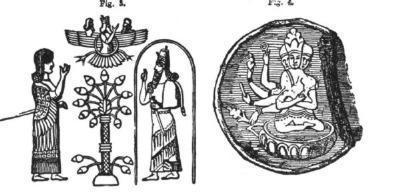
** Babylon and Nineveh. Some have said that the plural form of the name of God, in the Hebrew of Genesis, affords no argument of the doctrine of plurality of persons in the Godhead, because the same word in the plural is applied to heathen divinities. But if the supreme divinity in almost all ancient heathen nations was triune, the futility of this objection must be manifest.
*** Japhet, p. 184.
The three heads are differently arranged in Layard's specimen, but both alike are evidently intended to symbolise the same great truth, although all such representation of the Trinity necessarily and utterly debase the conceptions of those, among whom such images prevail, in regard to that sublime mystery of our faith.
In India, the supreme divinity, in like manner, in one of the most ancient cave-temples, is represented with three heads on one body, under the name of "Eko Deva Trimurtti," "One God, three forms." *
* Col. KENNEDY'S Hindoo Mythology. Col. Kennedy objects to the application of the name "Eko Deva" to the triform image in the cave-temple at Elephanta, on the ground that that name belongs only to the supreme Brahm. But in so doing he is entirely inconsistent, for he admits that Brahma, the first person in that triform image, is identified with the supreme Brahm; and further, that a curse is pronounced upon all who distinguish between Brahma, Vishnu, and Seva, the three divinities represented by that image.
In Japan, the Buddhists worship their great divinity, Buddha, with three heads, in the very same form, under the name of "San Pao Fuh." All these have existed from ancient times. While overlaid with idolatry, the recognition of a Trinity was universal in all the ancient nations of the world, proving how deep-rooted in the human race was the primeval doctrine on this subject, which comes out so distinctly in Genesis. *
* The threefold invocation of the sacred name in the blessing of Jacob bestowed on the sons of Joseph is very striking: "And he blessed Joseph, and said, God, before whom my fathers Abraham and Isaac did walk the God which fed me all my life long unto this day, the Angel which redeemed me from all evil, bless the lads" (Gen 48:15,16). If the angel here referred to had not been God, Jacob could never have invoked him as on an equality with God. In Hosea 12:3-5, "The Angel who redeemed" Jacob is expressly called God: "He (Jacob) had power with God: yea, he had power over the Angel, and prevailed; he wept and made supplication unto him: he found him in Bethel, and there he spake with us; even the Lord God of Hosts; The Lord is his memorial."
When we look at the symbols in the triune figure of Layard, already referred to, and minutely examine them, they are very instructive. Layard regards the circle in that figure as signifying "Time without bounds." But the hieroglyphic meaning of the circle is evidently different. A circle in Chaldea was zero; * and zero also signified "the seed."
* In our own language we have evidence that Zero had signified a circle among the Chaldeans; for what is Zero, the name of the cypher, but just a circle? And whence can we have derived this term but from the Arabians, as they, without doubt, had themselves derived it from the Chaldees, the grand original cultivators at once of arithmetic, geometry, and idolatry? Zero, in this sense, had evidently come from the Chaldee, zer, "to encompass," from which, also, no doubt, was derived the Babylonian name for a great cycle of time, called a "saros." (BUNSEN) As he, who by the Chaldeans was regarded as the great "Seed," was looked upon as the sun incarnate, and as the emblem of the sun was a circle (BUNSEN), the hieroglyphical relation between zero, "the circle," and zero, "the seed," was easily established.
Therefore, according to the genius of the mystic system of Chaldea, which was to a large extent founded on double meanings, that which, to the eyes of men in general, was only zero, "a circle," was understood by the initiated to signify zero, "the seed." Now, viewed in this light, the triune emblem of the supreme Assyrian divinity shows clearly what had been the original patriarchal faith. First, there is the head of the old man; next, there is the zero, or circle, for "the seed"; and lastly, the wings and tail of the bird or dove; * showing, though blasphemously, the unity of Father, Seed, or Son, and Holy Ghost.
* From the statement in Genesis 1:2, that "the Spirit of God fluttered on the face of the deep" (for that is the expression in the original), it is evident that the dove had very early been a Divine emblem for the Holy Spirit.
While this had been the original way in which Pagan idolatry had represented the Triune God, and though this kind of representation had survived to Sennacherib's time, yet there is evidence that, at a very early period, an important change had taken place in the Babylonian notions in regard to the divinity; and that the three persons had come to be, the Eternal Father, the Spirit of God incarnate in a human mother, and a Divine Son, the fruit of that incarnation.